
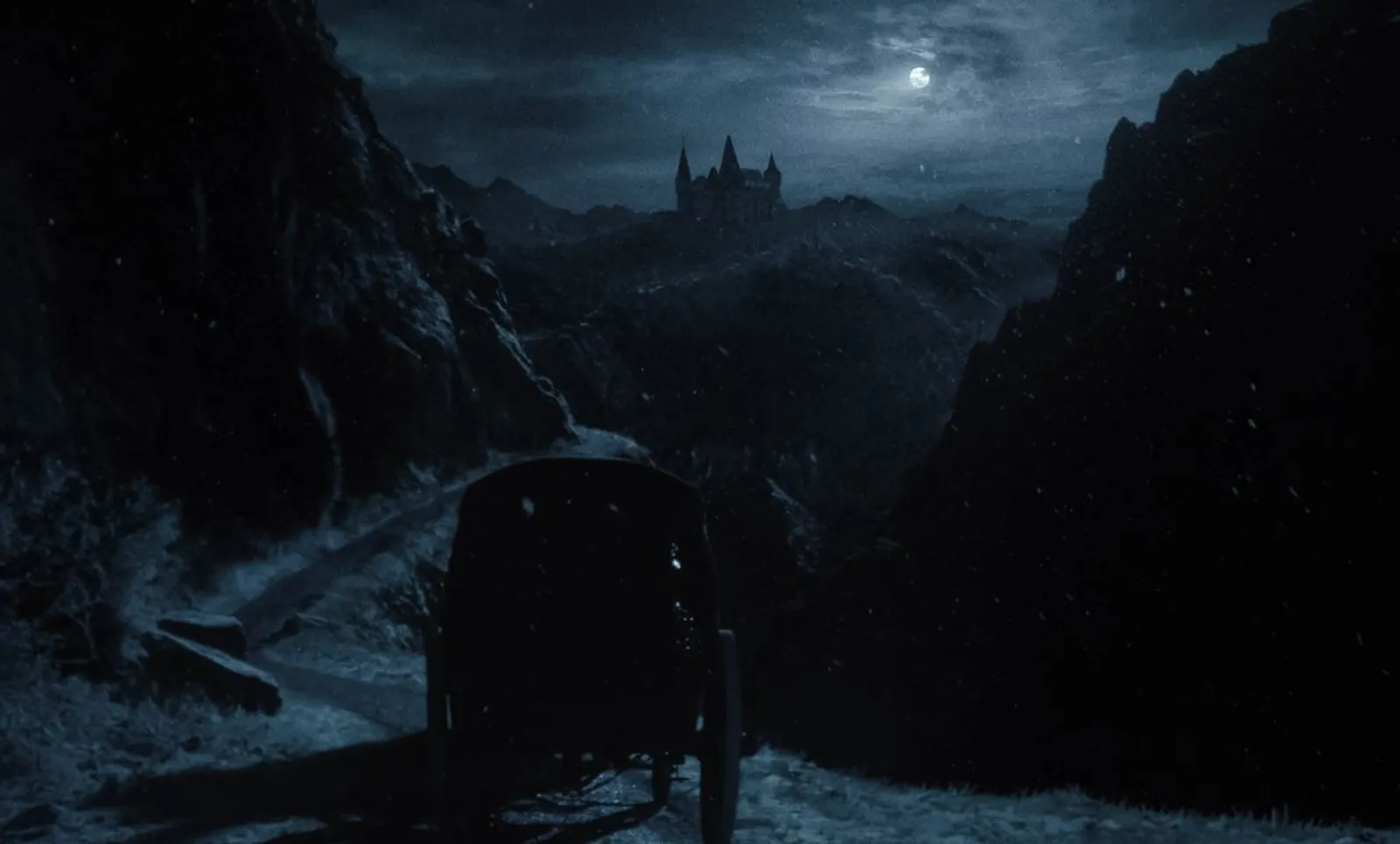
FILM REVIEW · GOTHIC VAMPIRE HORROR
A man visits a castle. A woman senses the nightmare before it reaches her door.
Robert Eggers returns to one of horror cinema’s oldest vampires and finds a story about longing, fear and a darkness that cannot be reasoned away. A spoiler-free look at the plot, performances, haunting visual style and who should watch.
Spoiler-free review · Cast and characters · Official film and production sources
Nosferatu (2024) is an old story told with an unusually physical sense of dread. A young estate agent travels to a remote castle to complete a property deal. His wife, already troubled by frightening visions, fears that something terrible is drawing closer. The figure at the centre of it all, Count Orlok, is less a seductive stranger than a presence that seems to drain warmth from every room it enters.
This Nosferatu (2024) review looks at what Robert Eggers brings to the vampire myth: the film’s Gothic atmosphere, the uneasy emotional triangle, the work of Lily-Rose Depp and Bill Skarsgård, and the remarkable effort invested in making darkness visible. It is written for readers who have not seen the film, so we will not reveal its final act or explain the ending.
Released in U.S. theatres on December 25, 2024 by Focus Features, Nosferatu is not a new October 2026 premiere. It remains an obvious choice for Halloween because its horror comes from ancient places, threatening silence and the sensation that a private fear has become a public catastrophe. For more films in that tradition, see our gothic horror movies for Halloween collection.
Inside this review
Nosferatu (2024) at a glance
| Original release | December 25, 2024 (United States) |
|---|---|
| Director and writer | Robert Eggers |
| Genre | Gothic horror, vampire drama |
| Theatrical runtime | 132 minutes (2 hours 12 minutes) |
| Extended cut | Approximately 136 minutes, available on select home releases |
| US classification | R — bloody violent content, graphic nudity and some sexual content |
| Primary studio | Focus Features / Universal Pictures |
The quick facts come from Focus Features and Universal Pictures Home Entertainment. The extended version is a home-release option, not a separate new film. Availability of particular editions depends on the country and retailer.
What is Nosferatu (2024) about? A spoiler-free story guide
Thomas Hutter, played by Nicholas Hoult, is an ambitious young estate agent hoping to secure a better future for himself and his wife, Ellen. His employer sends him on a long journey to meet Count Orlok, a reclusive nobleman in Transylvania who intends to purchase a property. The assignment sounds routine on paper. The closer Thomas gets to the castle, however, the more fragile that explanation becomes.
Back in Germany, Ellen (Lily-Rose Depp) struggles with disturbing experiences she cannot easily share with those around her. Thomas’s departure leaves her among friends whose confidence and conventional explanations offer little comfort. The separation between husband and wife is important: the film lets two kinds of terror grow at once, one attached to an isolated castle and the other unfolding in the supposedly secure space of home.
Orlok’s desire to reach Ellen is the engine of the story. Robert Eggers uses that pursuit to connect private longing with an increasingly collective nightmare. The consequences eventually reach people who have never met the count. Rather than giving every mystery away in its first act, the film allows the audience to feel the distance between the characters’ everyday expectations and the supernatural danger around them.
This basic premise is rooted in the earlier Nosferatu tradition, but the new film places greater emphasis on Ellen’s experience. Focus Features describes the project as a story of obsession, and that framing is a useful guide: the stakes are not simply whether a vampire can be stopped, but how much control the people caught in his orbit have over their own lives.
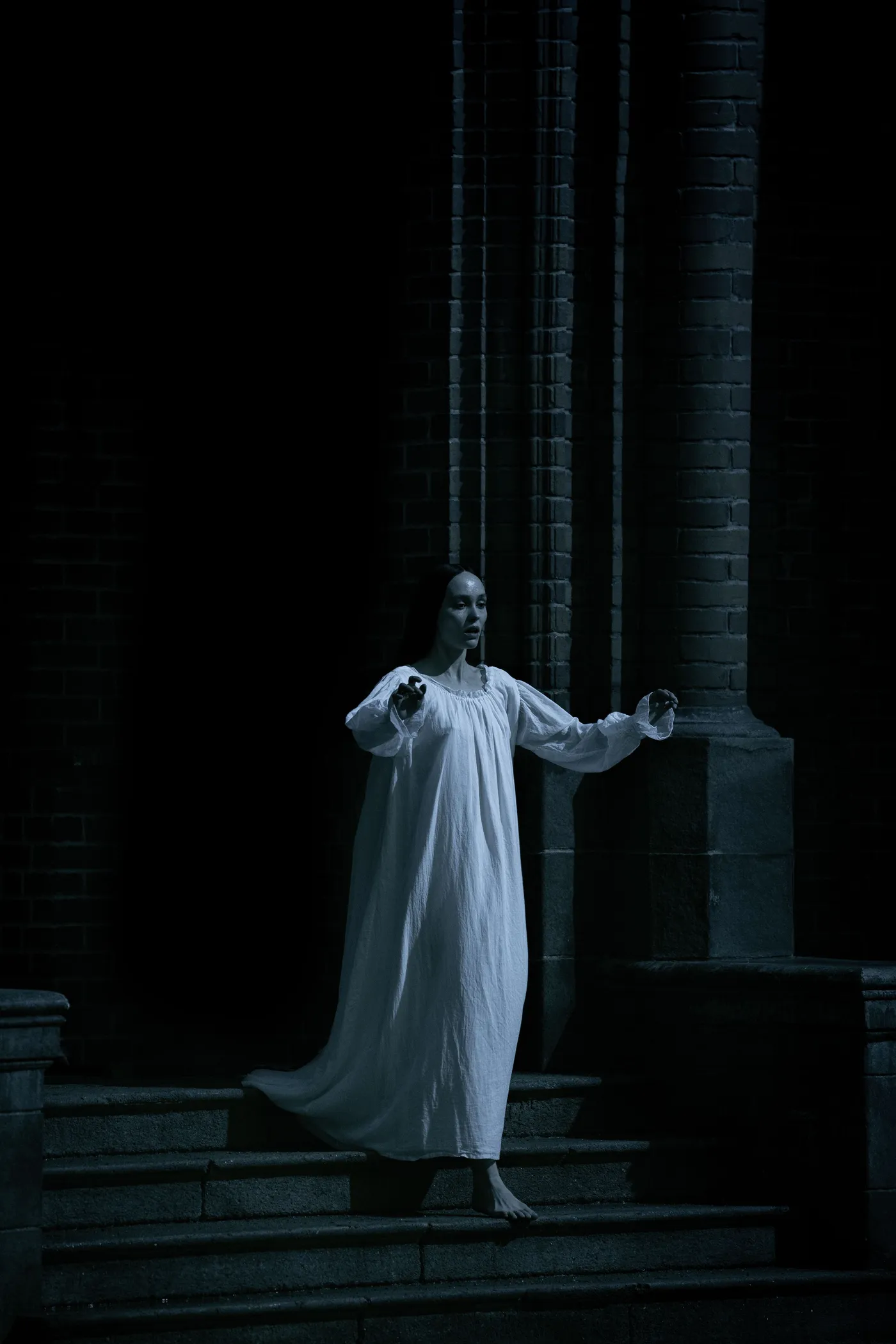
Lily-Rose Depp’s Ellen Hutter: more than the vampire’s victim
Ellen is the emotional centre of Eggers’ version. She senses a terrible connection long before the people around her accept that the threat might be real. That makes her predicament especially painful: her fear is urgent, yet the language available to explain it is inadequate. Friends and authority figures keep searching for familiar causes while Ellen confronts a force that seems to recognise her intimately.
Depp’s role asks for a difficult balance. Ellen must be vulnerable without becoming an empty symbol of helplessness; her reactions need to suggest an inner life even when the supernatural overwhelms ordinary conversation. The film’s central tension arises from that struggle between being seen as fragile and having an experience no one else understands. Her distress matters because the story never treats her as merely another frightened face in a haunted room.
Costume designer Linda Muir told Focus Features that Ellen’s clothes were designed to express youth and fragility, and that different versions of her nightgown were made for particular scenes. The practical decisions serve a narrative purpose: fabric, movement and the contrast between domestic clothing and the surrounding darkness help make Ellen feel exposed. Her relationship with Thomas also informs the choices; what matters to her is not a display of wealth, but an emotional connection.
For audiences drawn to character-focused horror, this is one of the film’s strongest ideas. Ellen’s story turns the familiar vampire plot into a question about whether people will listen when someone’s experience falls outside the rules they trust. That gives the supernatural images a human consequence beyond their immediate shock.
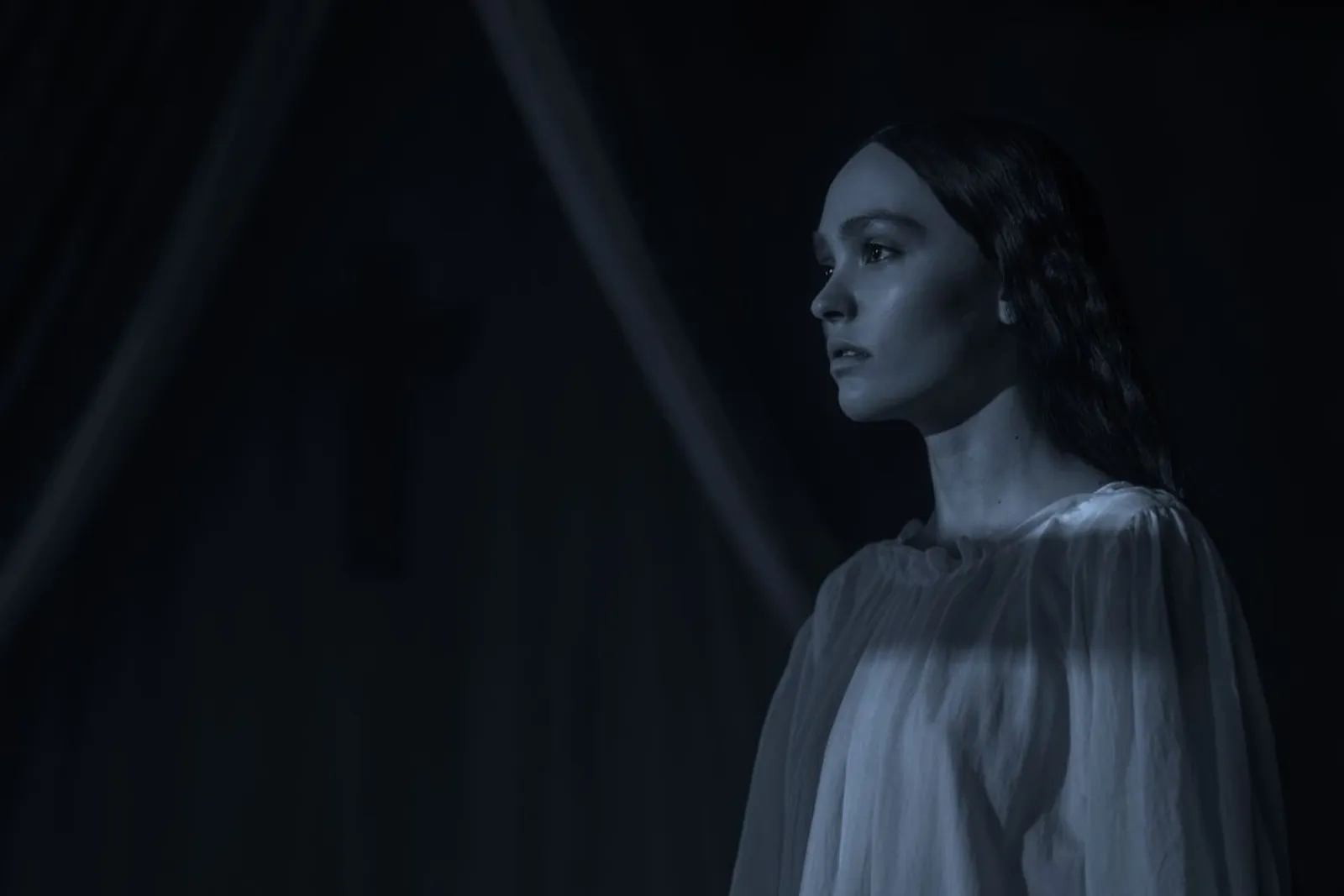
Bill Skarsgård’s Count Orlok: a vampire without the glamour
Count Orlok is not written as a romantic outsider the audience is invited to admire. His influence is frightening because it operates like an old disease or curse: once it enters a household, ordinary reassurance no longer works. The film’s Gothic language gives him the force of something that belongs to another age yet refuses to remain buried there.
Bill Skarsgård’s presence is central to that effect. Even before the film fully explains Orlok’s hold over Ellen, the vampire’s unnatural authority hangs over Thomas’s journey and the lives awaiting him at home. The character is disturbing not merely because of how he looks, but because the story keeps asking what happens when an obsession refuses to recognise another person’s autonomy.
Muir’s official costume interview offers a revealing detail about the design. The team imagined Orlok as a figure whose clothes belonged to an earlier historical period and whose body and wardrobe had decayed together. His garments were intended to obscure as much as reveal him, particularly when seen against firelight. That idea is more unsettling than an elaborate costume that simply announces a movie monster.
What the film gets right: Orlok’s menace is inseparable from the world around him. A castle, a contract, a closed room or a carriage through the landscape can all feel touched by the same threat. The horror builds outwards instead of depending on the count’s uninterrupted appearance on screen.
Why the shadows and cinematography matter
If there is one visual choice that defines Nosferatu, it is the refusal to light every corner for the audience’s convenience. Cinematographer Jarin Blaschke, who has worked repeatedly with Eggers, spoke to Focus Features about the challenge of filming lengthy scenes in spaces that were meant to have almost no light. Rather than simply making the picture black, the team worked to control small differences in tone so a face, sleeve or doorway could remain legible.
Blaschke explained that moonlit material was shaped by reducing warm colour information, leaving an impression closer to how people see in very low light. The result is a cold, drained visual world in which a slight movement can feel enormous. There are rooms that seem to swallow their inhabitants, and moments when what is outside the frame feels more significant than what is visible.
The photography also depends on deliberate framing. Eggers and Blaschke favour formal compositions that reflect the social codes of the period. A figure positioned at the end of a corridor, or kept at a measured distance from the camera, creates tension without the need to move rapidly from scare to scare. The film can feel almost ritualistic; that rhythm is part of the effect.
This is an unusually good reason to watch on the best screen available. It is a film whose images reward control over room lighting and attention to subtle details. A bright room or a phone with aggressively raised brightness may flatten the intended contrast between moonlight, firelight and darkness.
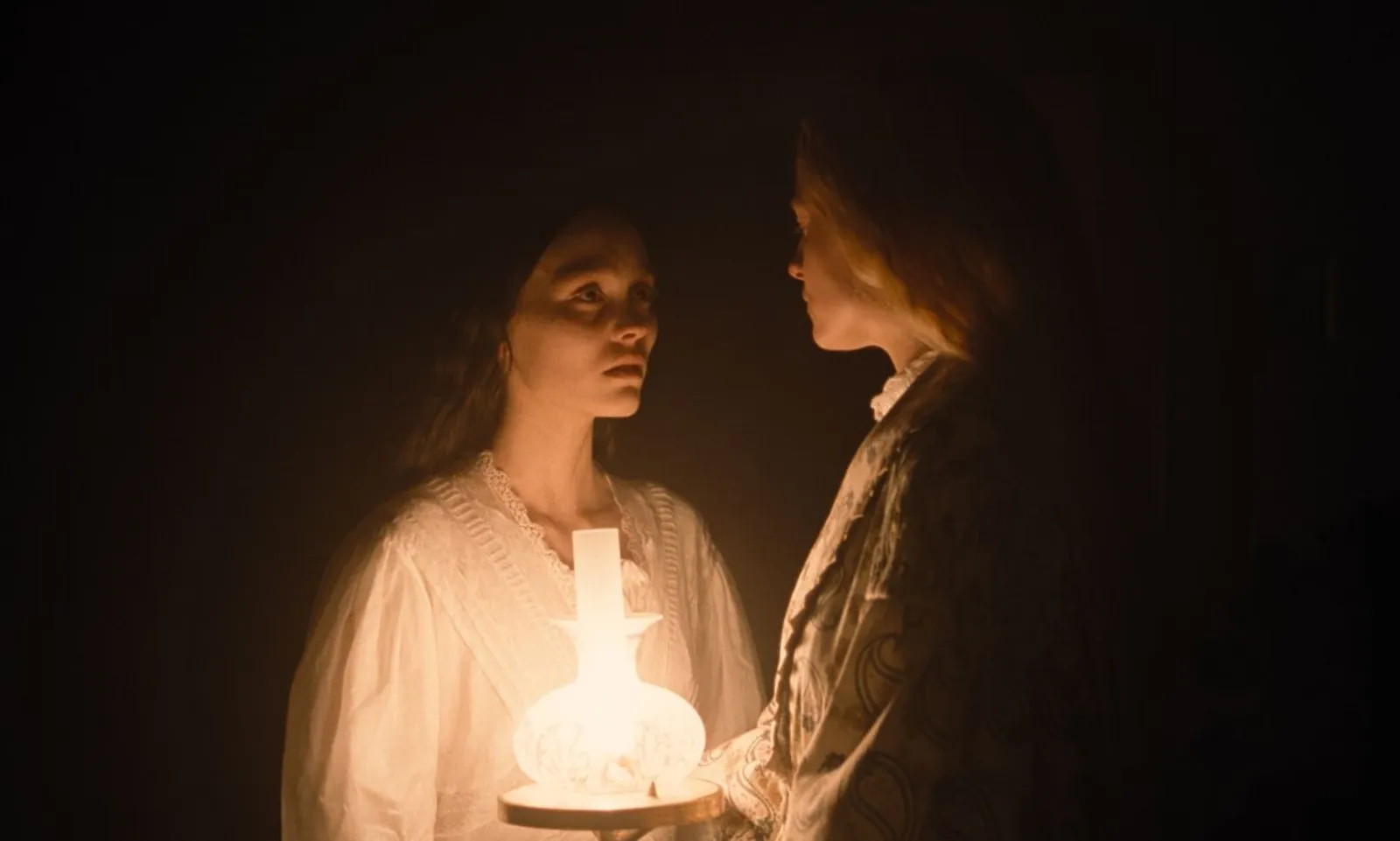
Costumes, sets and the feeling of 1838
The film is set in nineteenth-century Germany, and the production team approached the historical details seriously. Muir’s research into 1838 clothing included household manuals, paintings and the practical question of how people acquired and repeated garments. Those details might seem small beside an ancient vampire, but they give the human world a texture worth protecting.
The costume choices also describe class and temperament. Anna Harding, played by Emma Corrin, lives with the comforts and expectations of a wealthy household. Her clothing reflects that life, while Ellen’s wardrobe suggests a more inward character. The contrast helps the audience understand the women’s situations without lengthy explanations about the era’s domestic rules.
On the set-design side, the images make architecture feel almost sentient. Orlok’s castle is not merely a travel destination with a Gothic silhouette; it is a place where scale, stone and shadow work against Thomas. Domestic interiors carry a different anxiety, as familiar spaces gradually lose their claim to safety. The contrast between those two worlds allows the supernatural threat to feel both distant and impossibly close.
The film was recognised by the Academy with nominations for cinematography, production design, costume design and makeup and hairstyling. Those categories reflect a useful way of looking at the project: its fear is built through several departments working toward the same mood, not just through a single creature effect.
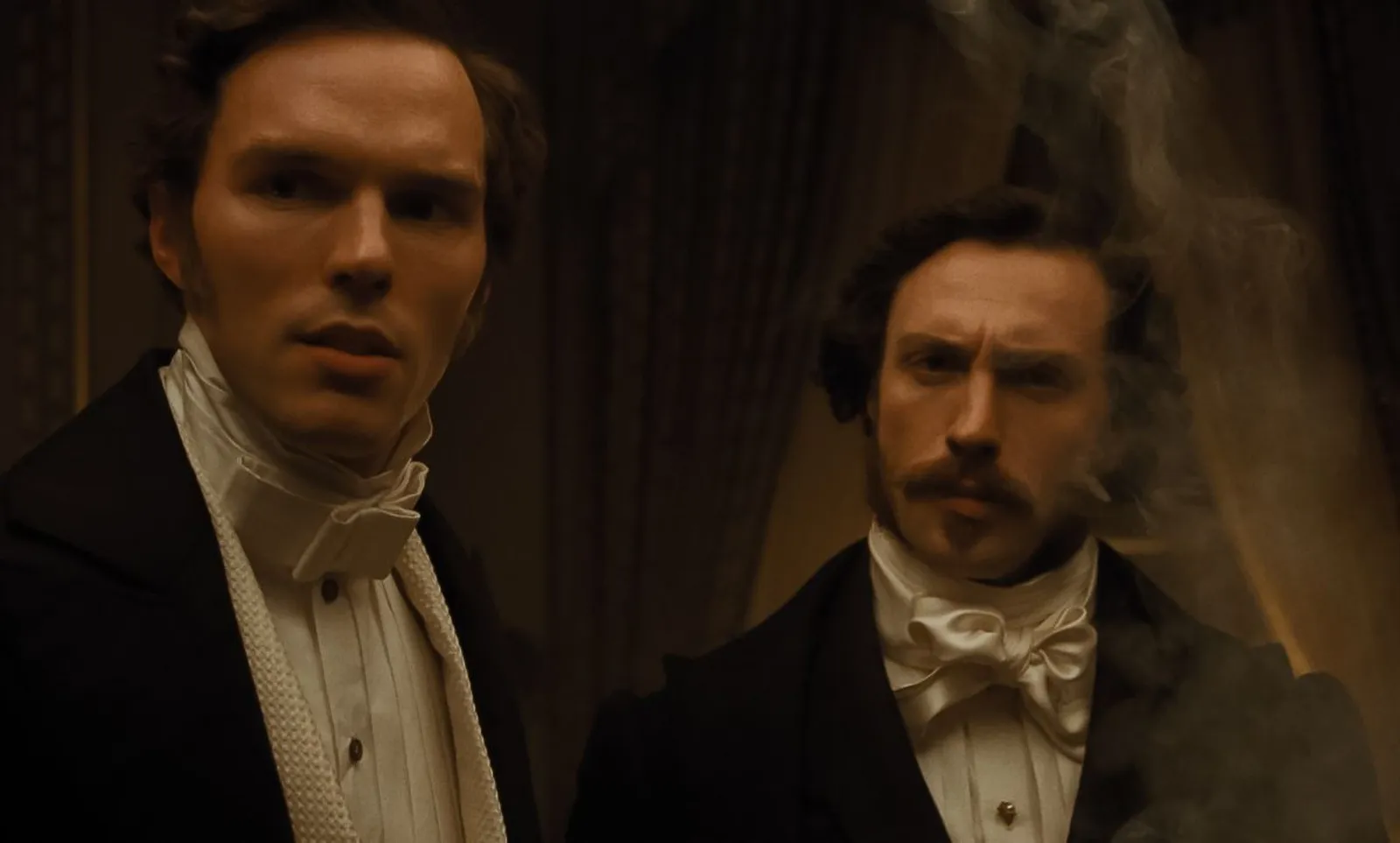
Nosferatu (2024) cast and characters
The cast mixes the couple at the centre of the haunting with friends, medical figures and men whose confidence in ordinary systems is tested. The story works best when these supporting characters do not all react to the supernatural in the same way.
| Actor | Character | Role in the story |
|---|---|---|
| Lily-Rose Depp | Ellen Hutter | A young woman experiencing frightening visions and an unwanted attachment |
| Nicholas Hoult | Thomas Hutter | Her husband, sent to negotiate with Count Orlok |
| Bill Skarsgård | Count Orlok | An ancient Transylvanian vampire |
| Aaron Taylor-Johnson | Friedrich Harding | A family friend trying to hold his world together |
| Emma Corrin | Anna Harding | Friedrich’s wife and Ellen’s friend |
| Willem Dafoe | Professor Albin Eberhart Von Franz | A scholar of the occult called upon as the danger grows |
| Simon McBurney | Herr Knock | Thomas’s unsettling employer |
| Ralph Ineson | Dr. Wilhelm Sievers | A doctor confronted with events outside conventional explanations |
Focus Features lists the principal actors on its official film page; its Willem Dafoe feature discusses Professor Von Franz’s function in the story. There is no need to learn every character name before watching, but the contrast between Ellen, Thomas and Von Franz is useful to keep in mind.
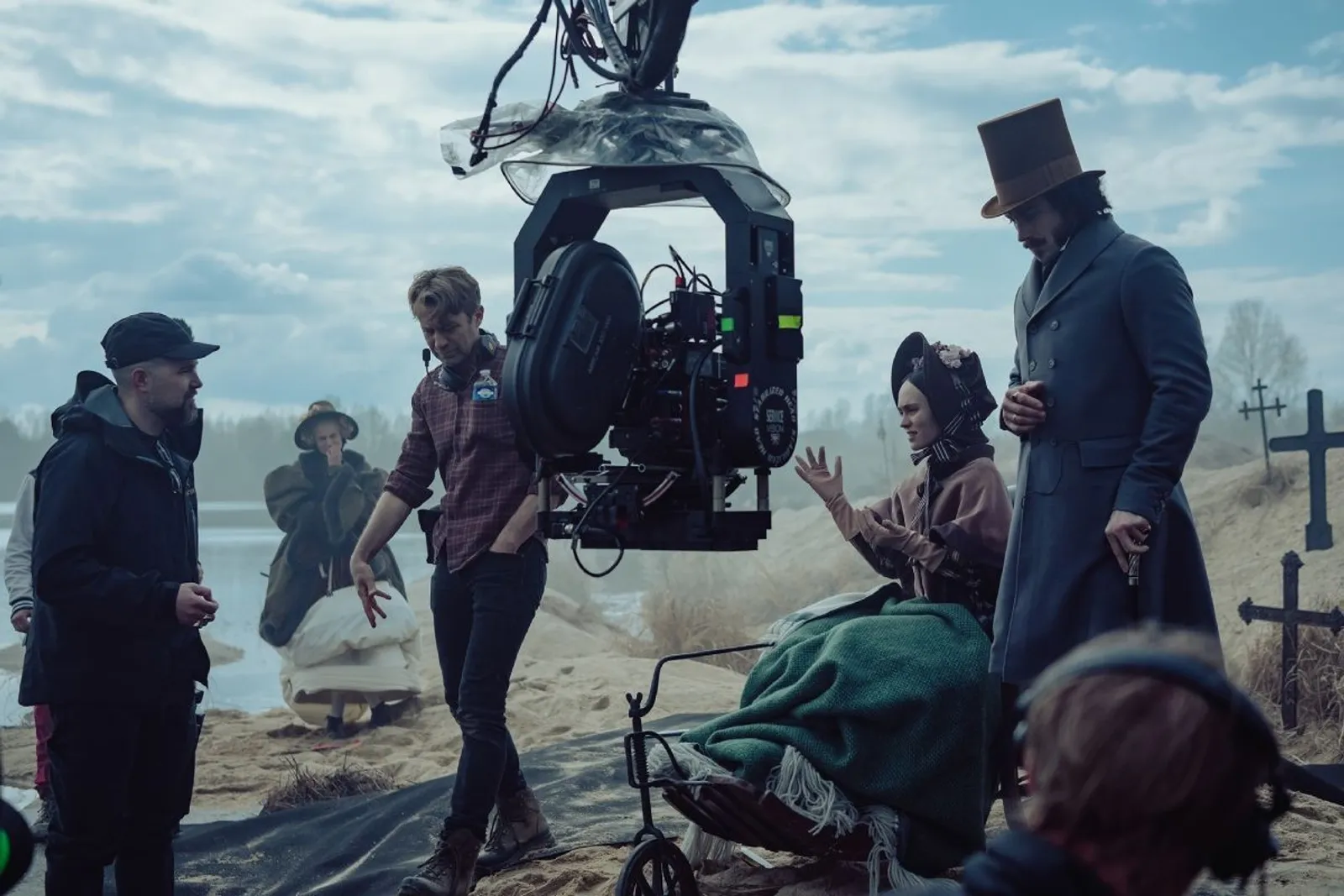
How Nosferatu (2024) relates to the 1922 classic
Nosferatu has had an unusually long afterlife. F. W. Murnau’s silent Nosferatu: A Symphony of Horror premiered in 1922 and drew on the structure of Bram Stoker’s Dracula, using its own names and setting. The shadowed figure of Count Orlok became one of horror cinema’s defining images. Eggers’ film returns to that lineage while giving its characters different psychological emphasis.
The modern version does not ask the viewer to have studied silent cinema. Thomas’s journey, Orlok’s obsession and Ellen’s fear are clear enough to stand on their own. But viewers familiar with Murnau’s images will recognise how much can be conveyed through a doorway, a silhouette or an unnaturally still figure. Eggers takes the visual grammar seriously without limiting his film to a shot-for-shot reconstruction.
The difference is especially apparent in Ellen. Official interviews with the cinematographer and costume designer both emphasise the greater attention given to her inner life in the new script. In that sense, revisiting a familiar vampire story offers more than nostalgia: it becomes an opportunity to ask whose terror, desire and decisions carry the narrative.
Did Nosferatu win any Oscars?
The film received four nominations at the 97th Academy Awards, in cinematography, production design, costume design, and makeup and hairstyling. The nominations are confirmed by the Academy’s official 2025 results and the Focus Features announcement. These were nominations, not wins.
Is Nosferatu (2024) worth watching?
For viewers who like Gothic horror, yes—provided they want atmosphere rather than a rapid succession of jump scares. The film’s strongest draw is the consistency of its world. It takes the sensation of dread seriously enough that a carriage ride, an old building or a figure standing too still can matter as much as the more explicitly supernatural moments.
The central relationship gives the movie a sharper emotional direction than a simple tale of a monster chasing victims. Ellen’s fear, Thomas’s journey and Orlok’s consuming fixation form a conflict about intimacy and control. Production design and cinematography reinforce that idea by making places look beautiful, remote and hostile at the same time.
There are good reasons why it will not suit everyone. Its pacing is deliberate, its mood is relentlessly grim, and its R-rated imagery includes graphic and sexual material. Someone looking for cheerful Halloween entertainment, a fast-moving modern creature feature, or a sympathetic romantic vampire may find Eggers’ approach exhausting rather than absorbing. That is a question of taste, not an indication that the film fails at what it attempts.
For a different Halloween mood, our mascot horror movies watchlist focuses on frightening entertainment characters; for a broader seasonal lineup, see the October 2026 horror guide. Neither of those lists presents this 2024 film as a new October 2026 release.
Where to watch Nosferatu (2024) legally
Focus Features provides a Watch at Home link on the official movie page. Universal Pictures Home Entertainment confirmed the U.S. digital purchase and rental release on January 21, 2025 and the 4K UHD, Blu-ray and DVD release on February 18, 2025. Availability changes with retailer and country, so check the local listing rather than assuming it is included with a particular subscription.
The home release also offers an extended cut at selected retailers. Universal lists the theatrical version at 2:12:25 and the extended version at 2:15:53, along with deleted scenes and a director’s commentary on eligible editions. If you are watching for the first time, the theatrical cut is a reasonable starting point; extras are best saved until afterwards.
Because Nosferatu has many editions and older films with the same name, confirm that the listing specifies Robert Eggers and 2024 before renting or buying.
Nosferatu (2024): frequently asked questions
What is Nosferatu (2024) about?
Robert Eggers’ film follows Thomas Hutter’s journey to Count Orlok’s castle and the ancient vampire’s dangerous obsession with Thomas’s wife, Ellen. It is a Gothic horror film about dread, desire and a supernatural threat that spreads beyond the castle.
Who plays Count Orlok in the 2024 Nosferatu movie?
Bill Skarsgård plays Count Orlok. Nicholas Hoult is Thomas Hutter, and Lily-Rose Depp plays Ellen Hutter.
How long is Nosferatu (2024)?
The U.S. theatrical version runs approximately 132 minutes (2 hours 12 minutes). Universal also lists an extended cut running about 136 minutes on selected home releases.
Is Nosferatu (2024) a remake of the 1922 film?
Yes. Robert Eggers reimagines F. W. Murnau’s silent horror classic from 1922, which itself was based on the broad story of Bram Stoker’s Dracula.
Why is Nosferatu rated R in the United States?
Universal lists an R rating for bloody violent content, graphic nudity and some sexual content. Local classifications may differ.
Is there an extended cut of Nosferatu?
Yes. Universal Pictures Home Entertainment announced an extended cut available through participating digital and physical releases, along with deleted scenes and filmmaker extras.
Did Nosferatu (2024) win four Academy Awards?
No. It received four Academy Award nominations at the 97th Oscars, for cinematography, production design, costume design and makeup and hairstyling. Nominations are not wins.
Is Nosferatu a new horror movie for Halloween 2026?
No. The film debuted in 2024. Its gothic atmosphere makes it a seasonal recommendation in a 2026 Halloween watchlist, not a 2026 release.
Official sources and editorial note
The release date, principal cast and premise were checked against Focus Features’ film page. Production analysis draws on Focus Features’ interviews with cinematographer Jarin Blaschke and costume designer Linda Muir. Runtime, age classification and the extended home edition were cross-checked against Universal’s January 2025 home-entertainment announcement. Awards information comes from Focus Features’ Oscars announcement. The story discussion is spoiler-free; critical judgments are KINOLIST editorial analysis, not quotes or review scores attributed to other critics.
Reviewed and updated October 19, 2026. Official film photos and behind-the-scenes imagery are credited beneath their respective images. No ending spoilers or invented 2026 release date.
1 thought on “Nosferatu (2024) Review: Story, Cast & Gothic Horror”