
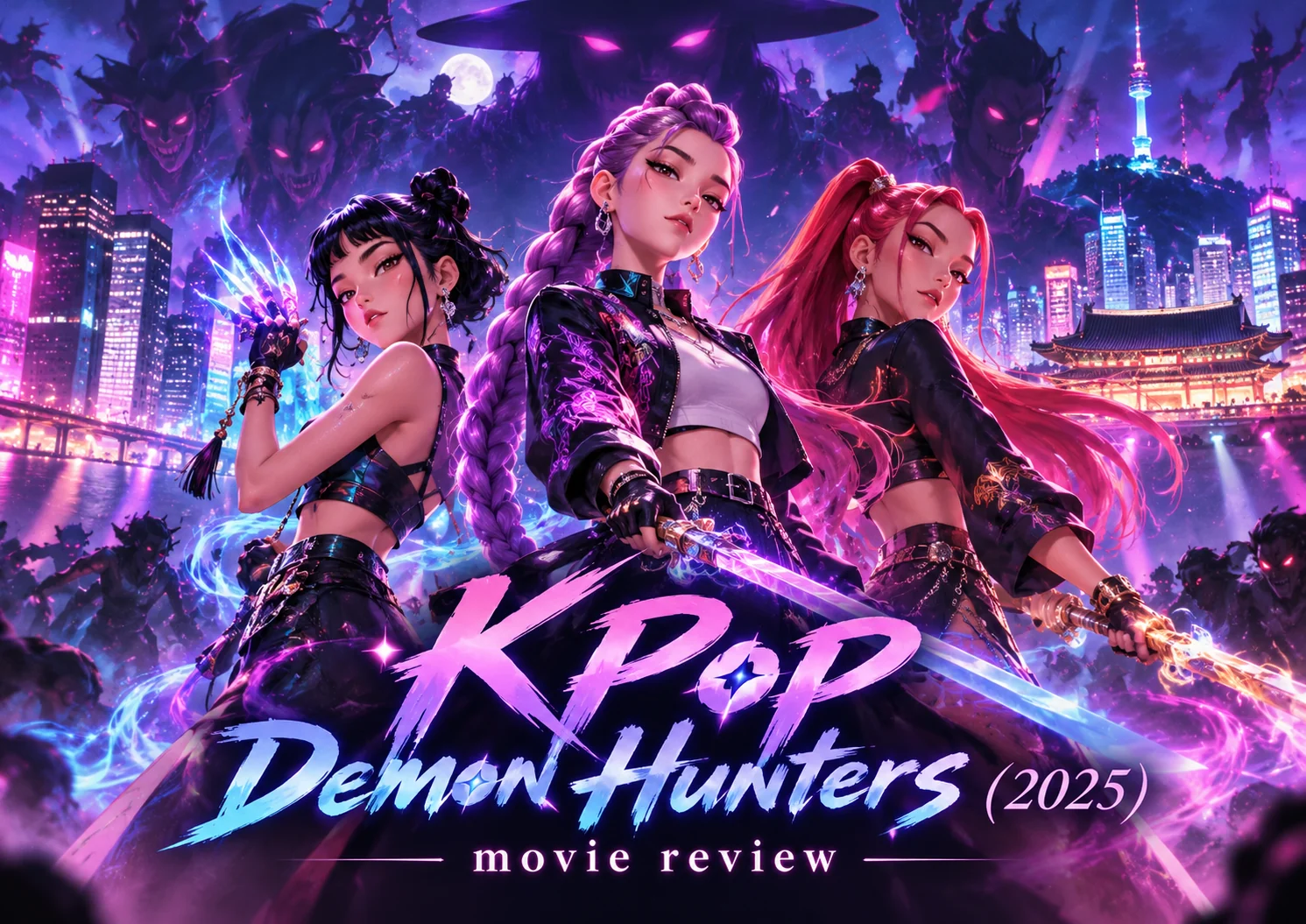
MOVIE REVIEW · ANIMATED MUSICAL · FANTASY · 2025
Saving the world is a concert. Being yourself is the hard part.
An in-depth KPop Demon Hunters review: the HUNTR/X trio, Jinu and the Saja Boys, the Golden soundtrack phenomenon, voice cast, Oscar wins, sequel news, and where to stream on Netflix.
Spoiler-light · Plot · Characters · Music · Animation · Oscars · Streaming · FAQ
KPop Demon Hunters (2025) has one of those concepts that sounds tailor-made for a trailer: three stadium-filling pop stars secretly fight demons between concerts. It would have been easy to turn the idea into an hour and a half of flashy songs with supernatural battles sprinkled between them. Instead, directors Maggie Kang and Chris Appelhans have made a musical whose bright surface conceals a surprisingly personal story about shame, trust and the exhaustion of performing an ideal version of yourself.
That’s what gives the animated film its staying power. Rumi, Mira and Zoey may inhabit a fantasy in which fan enthusiasm can help protect the world, but their friendship is grounded in recognizable tensions. The pressure to remain perfect is enormous. One bandmate tries to hide something fundamental about her identity; the others are struggling to understand why the group no longer feels entirely united. Their demonic enemies quickly discover that attacking the bond between singers and fans can be more effective than confronting a warrior with a weapon.
Our KPop Demon Hunters review goes beyond the soundtrack’s obvious hits to examine the story, voice and singing casts, visual style, Korean influences, and what the film has to say about belonging. We discuss its central themes without giving away the ending. Produced with Sony Pictures Animation, the film debuted on Netflix on June 20, 2025 and went on to win two Academy Awards in March 2026, for Best Animated Feature and Best Original Song for Golden.
KPop Demon Hunters plot: how a concert becomes a battle
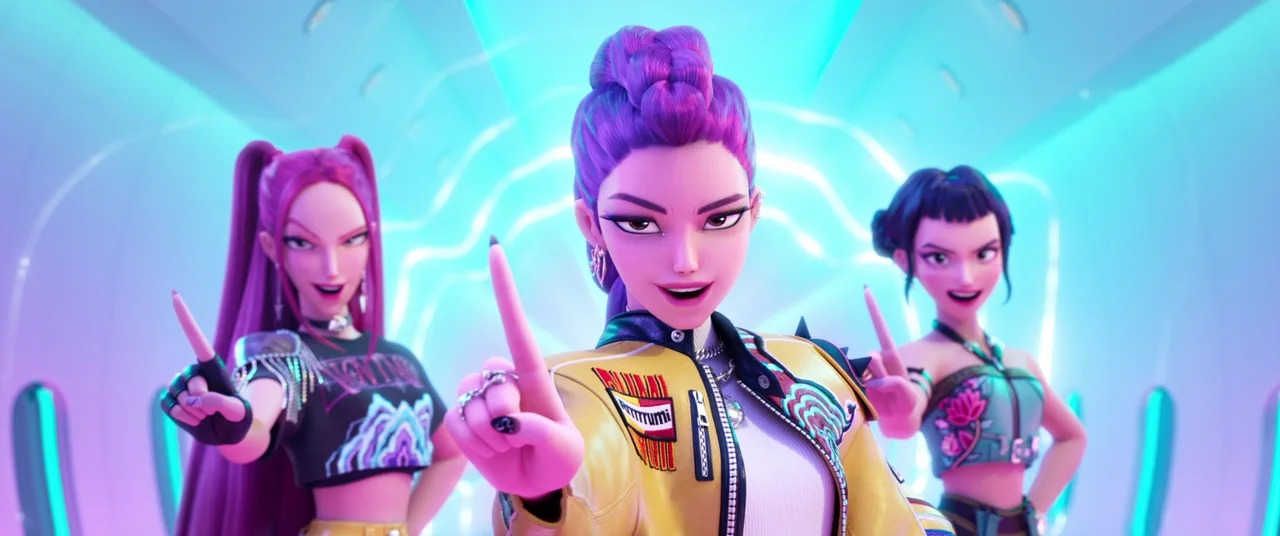
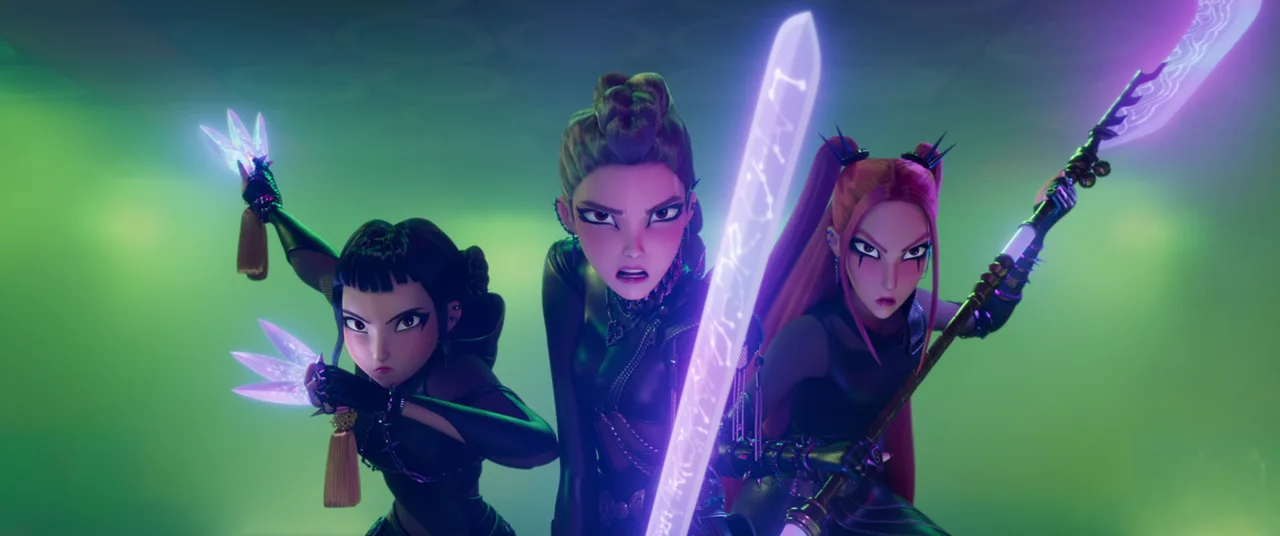
Rumi, Mira and Zoey are the members of HUNTR/X, an enormously successful K-pop girl group. To their fans, they are charismatic performers with explosive choreography, memorable songs and an effortless ability to make an arena feel united. Behind the stage lights, they belong to a tradition of demon hunters who use their voices to protect humanity. Their music strengthens a supernatural barrier known as the Honmoon, standing between the human world and the creatures that want to invade it.
At first, this dual identity appears almost manageable. The girls are talented at both performing and fighting; the same teamwork that supports their music also drives their action sequences. But their opponents change tactics. The demon realm sends a devastatingly popular boy band into the music business, and the newcomers promptly become an obsession for the public. The Saja Boys are charming, immaculately styled and suspiciously good at attracting the audience HUNTR/X depends upon.
The rivalry is not merely a contest for chart positions. If the Saja Boys can weaken the emotional connection between HUNTR/X and their fans, the protection over the human world may also weaken. Meanwhile, Rumi’s private anxieties threaten her relationship with the other members, and the Saja Boys’ enigmatic frontman Jinu introduces another set of conflicting loyalties. The film uses the competition to test what each character understands about honesty, duty and whether someone can ever completely escape their past.
The premise could support a conventional fantasy thriller, but the movie has a more enjoyable trick: a great performance is also an action scene. The music doesn’t interrupt the story; it helps determine what happens next. That makes the conflict accessible even to viewers who do not normally listen to K-pop. The stakes are clear because the stage itself has become part of the supernatural world.
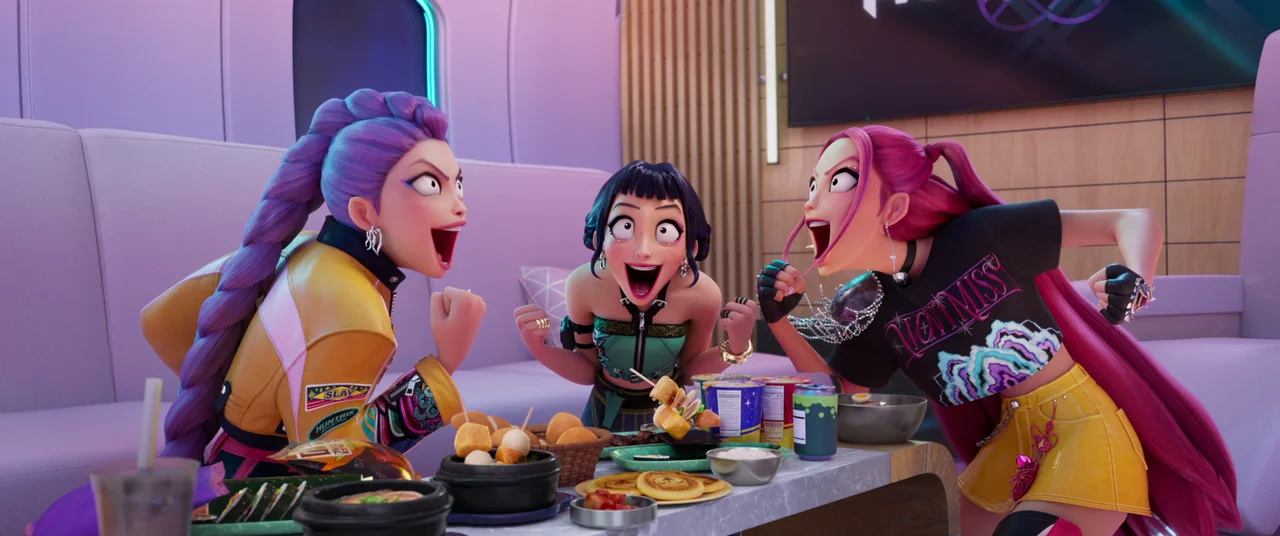
Rumi, Mira and Zoey: three personalities, one HUNTR/X
Rumi is the group’s disciplined leader, driven by the feeling that the others are relying on her to keep everything together. To the public, she radiates confidence. In private, she is preoccupied with a secret she fears could threaten her friends’ trust. This tension gives the character depth beyond the familiar animated archetype of a hardworking team captain. Her problem is not a lack of courage in a fight; it is a difficulty accepting the parts of herself that do not fit the image she has worked to perfect.
Mira contributes a different kind of strength. She is independent, direct and not always willing to follow a decision simply because Rumi makes it. That friction is useful to the drama. A friendship becomes more believable when its members can disagree without instantly turning into enemies. Mira asks the questions that someone in the group needs to ask, and her attitude keeps the story from treating loyalty as passive obedience.
Zoey supplies much of the humor, spontaneity and emotional warmth. Her more playful energy might seem secondary in an epic fight against demons, but a believable musical group needs a variety of voices. She gives HUNTR/X an approachable center when the pressure of fame and secrecy grows intense. Together, the three characters create a group that feels stronger because the members are different — and more vulnerable when they stop sharing what matters.
The best parts of their arc mirror what makes any close creative partnership difficult: there are audiences to satisfy, expectations to maintain and truths that can feel dangerous to confess. The story asks whether the members of HUNTR/X can protect the world without first learning how to protect their own friendship.
Jinu and the Saja Boys: why the villains steal the show
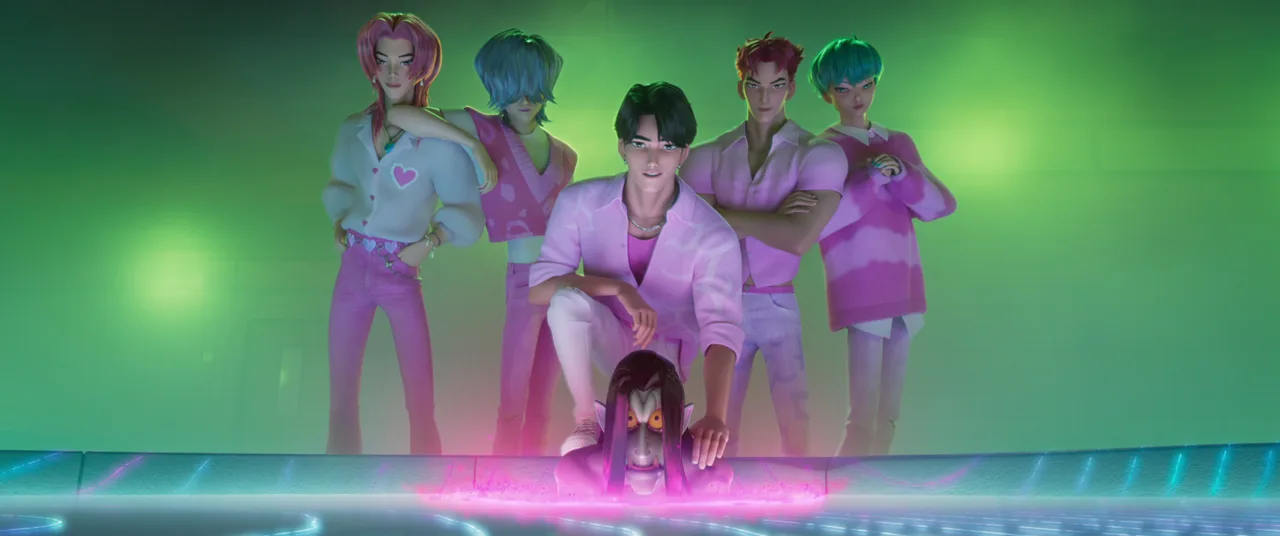
The Saja Boys are clever antagonists because they do not initially look like a supernatural threat. They understand branding, irresistible hooks and the culture of fan attachment. In a story where human emotion helps maintain a magical barrier, a rival boy band is a surprisingly practical weapon. The audience is meant to understand why people fall for their music even while recognizing that the group’s true intentions are dangerous.
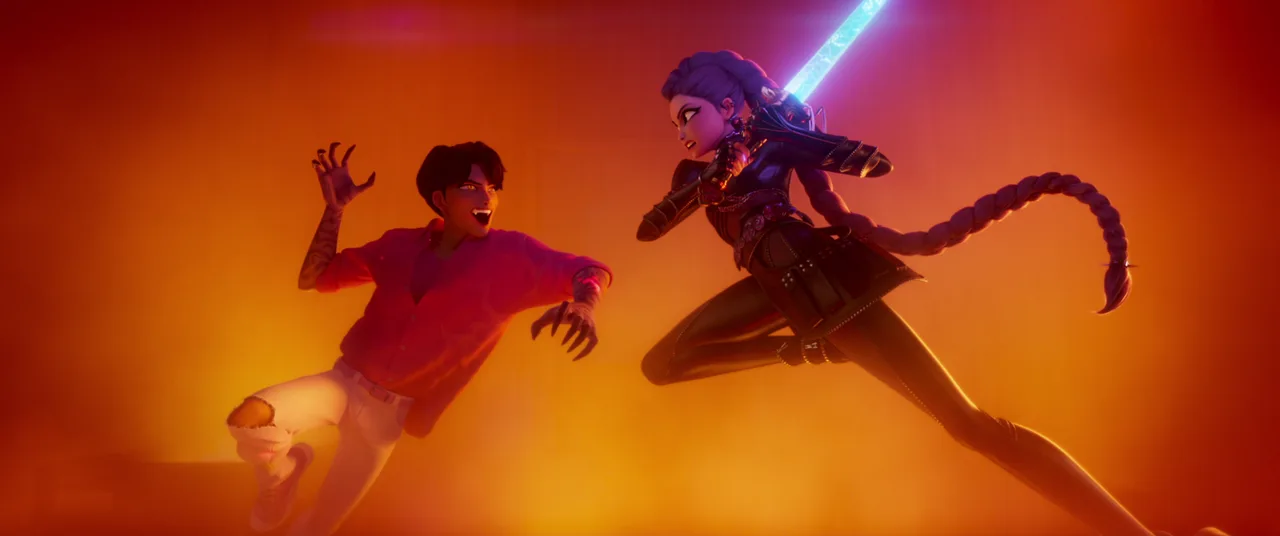
Jinu, voiced by Ahn Hyo-seop, is more complex than a beautifully designed villain with a tragic expression. His interactions with Rumi force the heroine to think about guilt and the possibility of change. The movie does not present their connection as a reason to overlook his allegiance, and that uncertainty helps it avoid becoming a predictable good-girl-meets-bad-boy romance. Personal choices remain meaningful even inside a world of magical bargains.
Musically, the Saja Boys are the ideal counterparts to HUNTR/X. Their first songs play with the innocence of bubblegum pop, while darker material reveals how fandom can become a form of control. They are entertaining enough that the threat never feels like a generic army of monsters. This is an important part of why the story’s premise works: both bands are convincing pop acts, even though one is trying to consume the world’s attention rather than earn it.
The soundtrack explained: Golden, Soda Pop, Your Idol and more
The music is the film’s most obvious attraction, yet its real achievement is structural. Songs have specific dramatic jobs. How It’s Done introduces HUNTR/X as both skilled fighters and compelling entertainers, blending battle choreography with the rhythm of a music-video performance. Takedown gives the trio a more aggressive attitude, while What It Sounds Like connects the musical form to the story’s ultimate emotional question without requiring a conventional spoken speech.
Golden is the defining number. It has all the qualities of a huge K-pop anthem — a soaring chorus, dramatic momentum and an invitation for the crowd to sing along. But the words are also bound to Rumi’s struggle with an identity she believes needs to be fixed or hidden. What first sounds like a straightforward declaration of self-confidence acquires a poignant double meaning. The song works as a pop single and as a character portrait, which is unusually difficult to achieve.
The rival group receives two particularly effective songs. Soda Pop hides sinister ambitions under the surface of irresistibly cheerful music, while Your Idol becomes an altogether darker demonstration of what the villains want from their followers. Both tracks help the Saja Boys remain memorable beyond their roles in individual scenes.
The HUNTR/X recording performances are delivered by EJAE, Audrey Nuna and REI AMI. These are distinct from the actors responsible for the characters’ spoken voices. Their recordings are a major reason the fictional band can be enjoyed outside the movie. The tracks function as contemporary pop releases rather than background cues, and their popularity has become an independent part of the film’s cultural footprint.
Golden won the Academy Award for Best Original Song in March 2026. Netflix has also documented the songwriting and production process, including the contributions of musicians associated with the contemporary Korean pop industry. The song’s success is striking, but it makes sense once the structure is examined: the film creates an emotional reason for a soaring chorus, and the chorus communicates that emotion even without the images.
Voice cast and singers: who performs the characters?
The distinction between speaking and singing performances matters especially in this movie. Arden Cho voices Rumi, May Hong voices Mira and Ji-young Yoo voices Zoey. Their dialogue performances establish the rhythm of the friends’ conversations and make the emotional scenes work even without the spectacular staging. For the songs, EJAE, Audrey Nuna and REI AMI bring the sound of a professional pop trio.
Among the supporting performers, Ahn Hyo-seop voices Jinu, and Lee Byung-hun voices the powerful demonic figure Gwi-Ma. The ensemble also includes Daniel Dae Kim, Ken Jeong, Yunjin Kim, Joel Kim Booster and Liza Koshy. This combination of recognizable screen performers and recording artists supports the movie’s unusual mixture of Korean-influenced pop culture and global animated entertainment.
For viewers choosing between dubbed and original audio, the songs are a particular consideration. Netflix offers different dubbing and subtitle options depending on the country and account. The English-original performances give a clearer sense of the intended vocal characterization, while a good localized soundtrack may make the dialogue easier for younger family members to follow.
Honmoon, Korean mythology and the story’s magical logic
The Honmoon is more than an excuse for a supernatural light show. It ties the band’s popularity to an ongoing responsibility: the energy and hope generated by their performances help keep demons away from humans. The metaphor gives the conflict a musical logic rather than asking the characters to abandon their careers whenever the plot needs another battle.
The filmmakers incorporate Korean-inspired spiritual imagery and cultural details within a contemporary urban fantasy. Monsters, traditional motifs and protective rituals coexist with social media, idol competitions and familiar modern Seoul environments. The effect is lively rather than museum-like. Viewers do not need prior knowledge of Korean folklore to follow the stakes, but the film encourages curiosity about the cultural references that shape its world.
There is also a clever irony in its understanding of fame. Pop stardom is often depicted as exhausting because an artist must continually manufacture approval. Here that approval has tangible value in the form of supernatural protection. The question becomes whether fan affection can remain powerful when a performer feels unable to be honest with the people closest to her.
Animation and direction: an animated film with music-video ambition
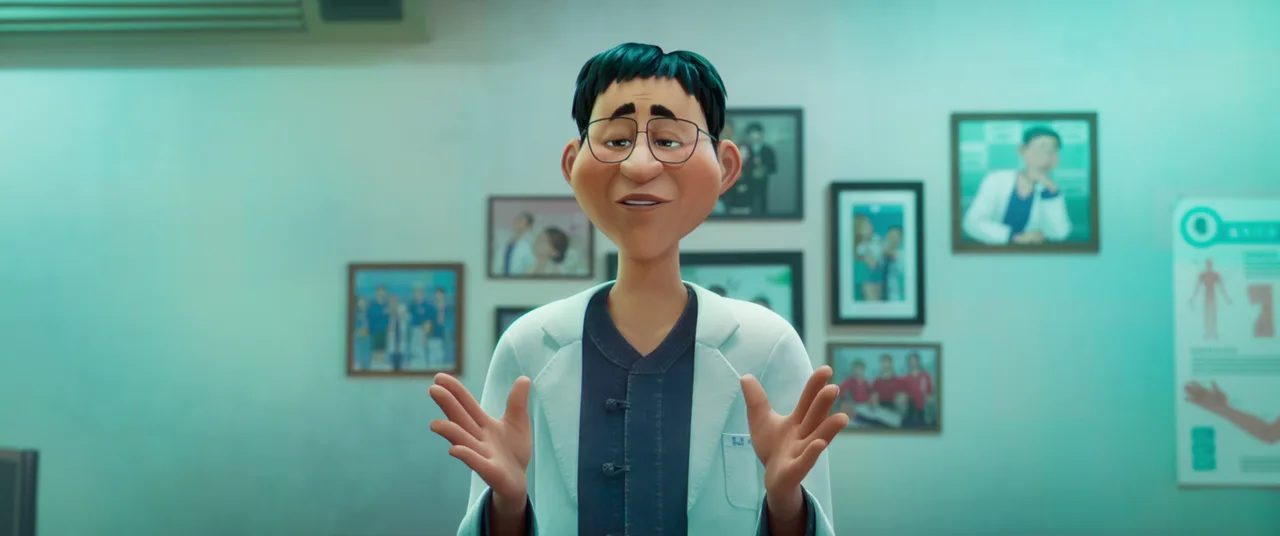
Sony Pictures Animation has shown that computer animation does not need to imitate live-action photography to feel cinematic. In KPop Demon Hunters, every visual decision appears designed to amplify emotion: character poses become exaggerated when comedy demands it, concert lighting transforms entire environments, and action sequences move with the crisp timing of choreography.
There are echoes of the studio’s broader interest in graphic stylization, although the film has its own identity. The heroines move between carefully polished idol performances and elastic physical humor. Demonic creatures can be genuinely threatening for a moment and then yield to the playful exaggeration of an animated musical. The shifting style keeps the movie energetic without requiring a single uniform tone.
The fight choreography is particularly effective when it is tied to a musical phrase. A movement that might be ordinary in a generic action sequence becomes memorable because of how it lands against the rhythm. Color, editing and movement therefore become part of the musical arrangement. If there is a downside, it is that the constant intensity can be overwhelming: quieter viewers may wish for an occasional extra scene of unhurried conversation.
Seoul and the surrounding pop-culture environment also feel like more than convenient scenery. The movie incorporates fashion, food, entertainment and urban life into its world-building, giving the fantasy a recognizable cultural texture. It invites a global audience into a particular vision rather than diluting every detail into a placeless Hollywood setting.
What the movie gets right about shame, identity and friendship
The emotional idea at the heart of the film is simple, but the musical form makes it resonate. Rumi has convinced herself that her worth depends on maintaining an image of flawless strength. Her sense of responsibility is sincere; so is her fear that the truth will change how her friends see her. As that fear grows, the skills that made her a good leader begin to work against her, encouraging secrecy when honesty is needed most.
The story does not suggest that everyone can overcome such anxiety by delivering a catchy lyric and smiling. It shows how withholding part of yourself can damage trust even when the original motive is protection. Mira and Zoey need a relationship with the real Rumi, not just the version who can manage every threat and sing every difficult note.
That’s why the musical metaphor lands. A group sounds strongest not when every member performs as though she has no flaws, but when the different voices can be heard without fear. The fantasy extends that idea into a literal force that can shape the world. For younger viewers, the message is accessible; for adults familiar with creative work or the pressures of public life, it carries extra weight.
What’s outstanding — and what might not work for everyone
The greatest strengths are the immediate appeal of the songs, the sharp differences among the heroines and the coherent connection between music and supernatural action. The Saja Boys provide antagonists whose charisma is part of their weapon, while Jinu adds an emotional complication that makes the battle more than an uncomplicated good-versus-evil scenario.
There are weaknesses too. Certain turns in the story are familiar from youth-oriented fantasy, and the supporting characters do not all receive comparable development. The film moves so fast that a revelation can be followed almost immediately by an elaborate performance or another fight. Listeners who strongly dislike contemporary pop may find the movie’s dependence on music a genuine barrier rather than a bonus.
Yet this is a musical first, and treating that as a flaw would miss what the filmmakers set out to achieve. Its action is meant to be thrilling, but the songs, design and characters are the real center. As a piece of contemporary animated entertainment, it delivers a recognizable sound and personality that continue to matter long after the main story ends.
Oscars, the Golden phenomenon and the official sequel
The film’s influence is reflected in the extraordinary reach of its soundtrack and in its awards. At the 2026 Academy Awards, it won Best Animated Feature and Best Original Song for Golden. Earlier recognition from music awards helped establish the song as much more than a novelty attached to a film release.
Netflix confirmed a KPop Demon Hunters sequel in March 2026, with Maggie Kang and Chris Appelhans returning as directors. The announcement confirms that the fictional group’s story is continuing, but there is no official fixed premiere date at the time of writing. Any rumored year should be treated as speculation unless Netflix supplies an actual release announcement.
The challenge for a sequel will be considerable. A new album of good songs would almost certainly be welcomed, but replicating the first film’s success depends on finding a fresh emotional dilemma for Rumi, Mira and Zoey. Their friendship, rather than the number of chart records or musical cameos, is what gives the franchise a lasting dramatic foundation.
Where to watch KPop Demon Hunters online
KPop Demon Hunters is streaming on Netflix — watch the full movie on the official site. Netflix has also released related musical content, with additional formats, including sing-along programming, available in some territories. Regional catalog information, age ratings and audio tracks can vary, so check the listing when signed into your local account.
For families, the film is colorful and frequently funny, but it contains demon imagery, fast-paced supernatural battles and emotionally intense moments. Consider the local parental guidance rating rather than assuming every child who enjoys pop music will be comfortable with the fantasy action.
The songs are also available through music services independently of the movie, but the original Netflix release remains the best way to understand how the tracks contribute to the narrative. No unofficial streams are necessary to explore the film.
Final verdict: is KPop Demon Hunters worth watching?
KPop Demon Hunters (2025) is well worth watching if you enjoy inventive animated musicals, exhilarating stage performances and stories about friendships under pressure. It may not convert every viewer into a devoted K-pop fan, but its confidence is infectious, and the writing has more emotional substance than its glossy premise initially suggests.
The most compelling thing about the film is not that the heroines are brilliant at singing and fighting. It is that their most difficult challenge requires neither a weapon nor a perfect chorus. They must learn to trust one another without pretending to be flawless. The combination of that theme with striking animation and a genuinely memorable soundtrack makes this a rare global pop-culture phenomenon with a strong story underneath.
KPop Demon Hunters (2025) — frequently asked questions
What is KPop Demon Hunters about?
The 2025 animated fantasy follows Rumi, Mira and Zoey, the members of K-pop group HUNTR/X, who secretly protect their fans from demons while competing with a seemingly irresistible rival boy band.
Is KPop Demon Hunters a movie or a series?
It is a feature-length animated film, released on Netflix on June 20, 2025. It is not a television series.
Who directed KPop Demon Hunters?
The film was directed by Maggie Kang and Chris Appelhans and produced by Sony Pictures Animation for Netflix.
Who voices Rumi, Mira and Zoey?
Arden Cho voices Rumi, May Hong voices Mira and Ji-young Yoo voices Zoey. Their singing voices are performed by EJAE, Audrey Nuna and REI AMI.
Who voices Jinu in KPop Demon Hunters?
Ahn Hyo-seop voices Jinu, the leader of the demonic rival boy band Saja Boys.
Who sings Golden from KPop Demon Hunters?
Golden is performed by EJAE, Audrey Nuna and REI AMI as the fictional group HUNTR/X.
What are the Saja Boys’ main songs?
Soda Pop and Your Idol are their two most prominent original songs, reflecting the group’s charming public image and darker supernatural identity.
How many Oscars did KPop Demon Hunters win?
The film won two Academy Awards in March 2026: Best Animated Feature and Best Original Song for Golden.
Is a KPop Demon Hunters sequel officially confirmed?
Yes. Netflix confirmed a sequel in March 2026, with Maggie Kang and Chris Appelhans returning to direct. No definitive release date was announced.
Where can I stream KPop Demon Hunters?
The film is available to stream on Netflix. Dubbed audio and subtitle options, along with age classifications, vary by region.
Verified sources: Sony Pictures Animation (film credits), Netflix Tudum guide (plot and cast), Netflix soundtrack guide, official sequel announcement, Sony Pictures Imageworks film-stills gallery.
Discover more film reviews on KINOLIST. Читайте обзор на русском →