
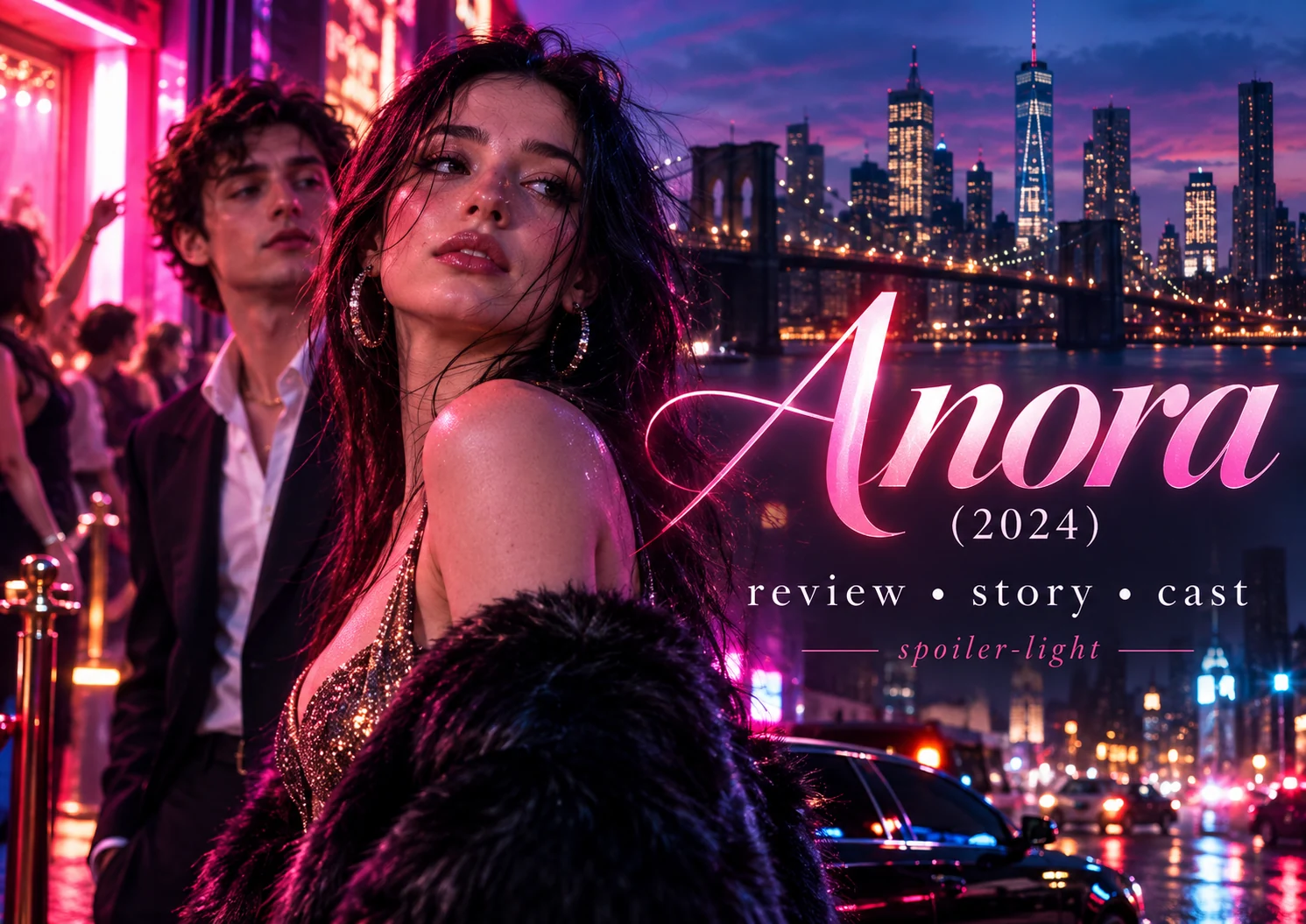
MOVIE REVIEW · COMEDY-DRAMA · 2024
A Cinderella story meets the price of real-world power.
Our spoiler-light Anora review explores Sean Baker’s genre-changing film, Mikey Madison’s extraordinary performance, Yura Borisov, the social themes, five Oscar wins and legal streaming options.
Spoiler-light · Story · Performances · Themes · Oscars · Streaming · FAQ
Anora (2024) begins with the promise of a fantasy and gradually asks who has the power to end that fantasy. Written, directed and edited by Sean Baker, the film introduces Ani, a resourceful young woman in Brooklyn whose impulsive marriage to the son of a Russian oligarch seems to offer a shortcut into a different life. Almost immediately, that apparent escape becomes a collision between people who can purchase solutions and people who have to live with the results.
It would be easy to describe this as a scandalous romantic comedy about a rich kid and an exotic dancer. That summary misses most of what makes the movie memorable. Our Anora (2024) review looks at the startling changes in tone, the way Mikey Madison gives Ani real authority over the screen, and why a story full of outrageous behavior becomes a painfully effective study of class, intimacy and personal dignity.
There is substantial context behind the attention. The movie won the 2024 Cannes Palme d’Or and then collected five Academy Awards in 2025, including Best Picture, Best Director and Best Actress. Those wins are documented by the Cannes Film Festival and the Academy. They make Anora an important awards title; they do not make its unruly, adult approach to romance any more conventional.
Anora (2024) plot explained — without ending spoilers
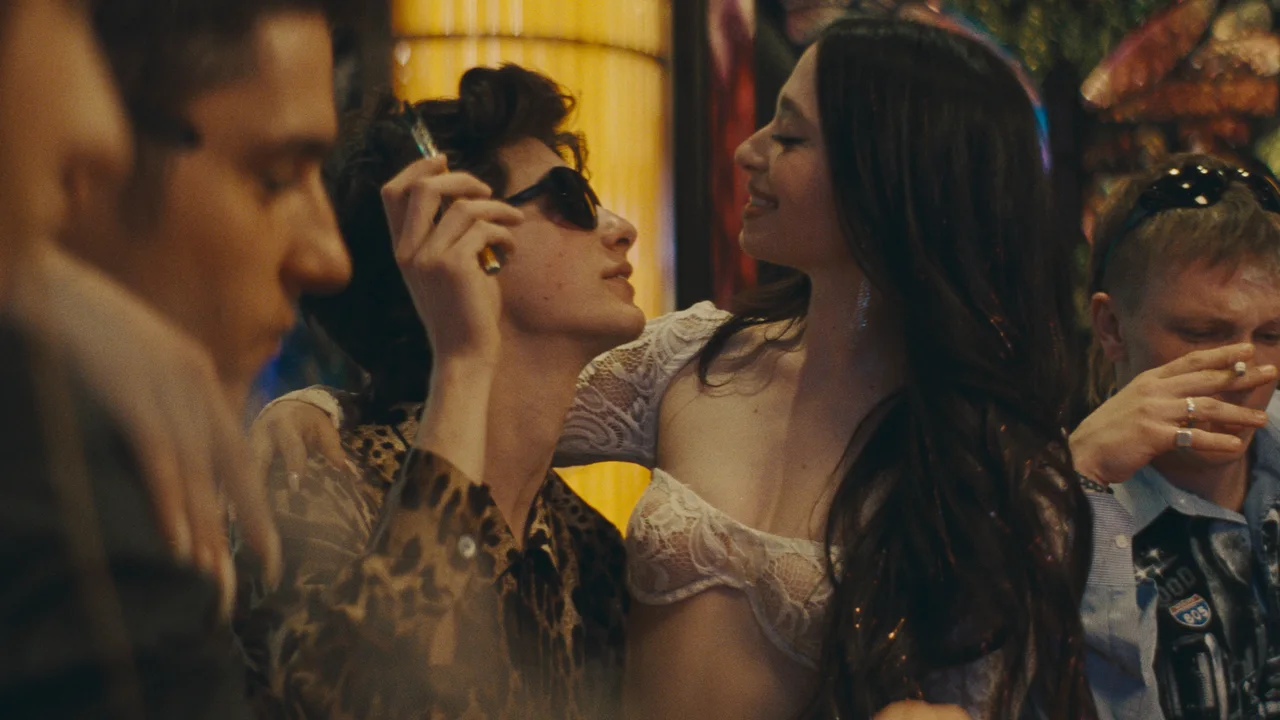
Ani works in a New York strip club and is familiar with the complicated art of presenting confidence while negotiating boundaries. When she meets Ivan, nicknamed Vanya, she encounters a young man with wealth, time to burn and seemingly little interest in limits. Their relationship accelerates through expensive evenings and spontaneous decisions. Soon they are married, and the contrast between Ani’s practical life and Ivan’s almost limitless financial safety net looks momentarily irrelevant.
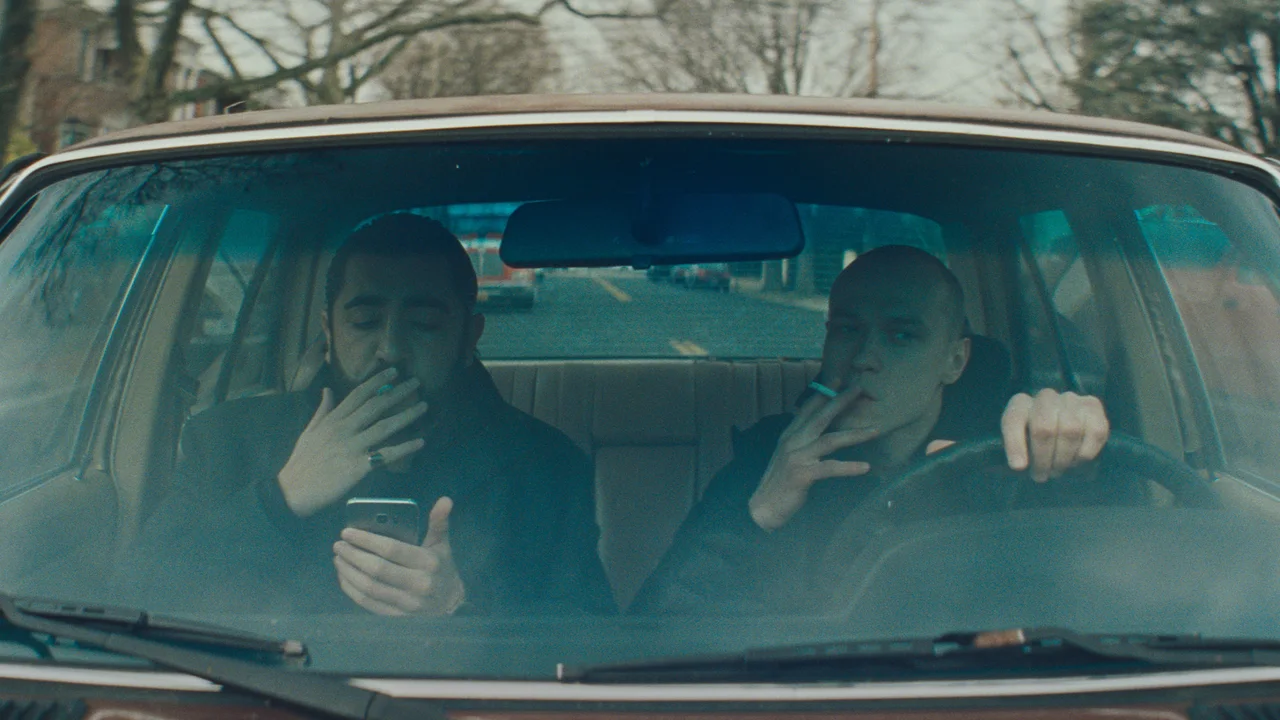
That impression does not last. Ivan’s family receives news of the wedding and treats the relationship as a problem to be corrected. People connected to the family are dispatched to New York to make the marriage disappear. As the situation escalates, a sequence of increasingly uncomfortable encounters sends the characters across the city in a frantic attempt to regain control.
For Ani, however, the marriage is not merely a wild anecdote. It contains real hopes about how life might change. Baker creates the dramatic pressure by making those hopes collide with a world in which powerful people expect their instructions to carry more weight than someone else’s choices. The story is unpredictable even when the basic premise is known, so the best way to experience it is without a detailed account of the final act.
Not quite a modern Cinderella romance
The film borrows the outline of a fairy tale precisely to reveal what that outline leaves out. In a traditional wish-fulfillment story, romance promises upward mobility, and the transformation is treated as its own justification. Baker is interested in the legal, social and emotional consequences. The protagonists are not entering the same bargain with equal advantages. A reckless decision can become a passing inconvenience for someone protected by family money, but a life-defining event for someone without that protection.
The difference gives the movie a particularly sharp sense of humor. People take themselves very seriously while behaving absurdly, and the audience is frequently invited to laugh at a spectacle that also feels threatening. Comedy provides momentum, yet it never entirely removes the underlying imbalance of power. The same episode can be staged like farce and still reveal how quickly an individual’s agency can be challenged.
That tonal uncertainty is one of the reasons Anora resists easy classification. It is a romance, a chaotic screwball comedy and a social drama, but never comfortably only one of those things. The shifting form is part of the argument: different people experience the same event as fantasy, entertainment, inconvenience or crisis.
Mikey Madison gives the film its emotional center
Madison’s performance is ferocious in a way that doesn’t depend on a single showcase monologue. Ani talks quickly, responds to insults almost instantaneously and often seems capable of outlasting anyone who tries to intimidate her. She is funny, observant and unwilling to be dismissed. What initially looks like unshakable confidence, however, gradually reveals itself as work. She must keep asserting her place because other characters assume they are entitled to move her aside.
Crucially, Baker and Madison do not smooth away Ani’s contradictions. She can be naïve about a promise and ruthlessly practical about money. She is capable of anger, tenderness and mistakes. The performance doesn’t ask viewers to approve of every decision before granting her sympathy. That generosity makes the character feel more like a person than a lesson about the dangers of wealth.
Madison won the 2025 Academy Award for Best Actress, and the achievement is not difficult to understand. Few roles require an actor to carry such rapid transitions from glamour to frustration, comedy to loneliness, and near-continuous motion to moments of unexpected stillness. The movie might have been overwhelmed by its own noisy plotting without her ability to make each turn feel personal.

Mark Eydelshteyn, Yura Borisov and the supporting cast
Mark Eydelshteyn plays Ivan with a restless, boyish energy. He can make the character charming in one moment and deeply frustrating in the next. That contrast is more than a personality quirk. Ivan has spent his life surrounded by structures that allow him to postpone responsibility. As a result, his enthusiasm for a romantic adventure does not necessarily mean he understands what it costs the other person.
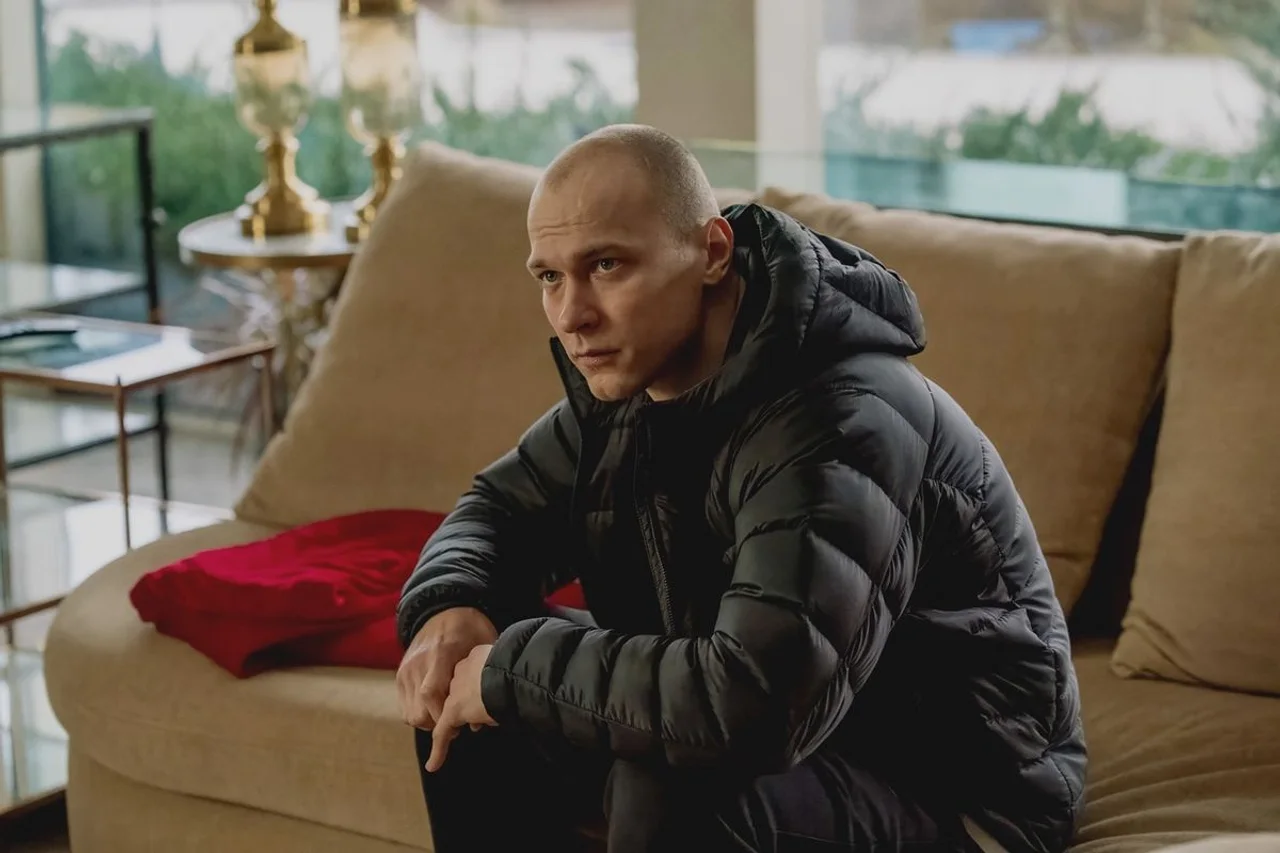
Yura Borisov, playing Igor, creates a striking counterweight. In scenes crowded with shouting and frantic improvisation, Igor often becomes most interesting by doing less. He observes, hesitates and allows brief traces of humanity to interrupt the family’s mission. Borisov received an Oscar nomination for Best Supporting Actor, a recognition of how much subtlety his quieter performance adds to a film that otherwise seems determined to increase its own volume.
Karren Karagulian and Vache Tovmasyan contribute to the movie’s magnificent disarray as figures attempting to manage a situation that keeps escaping them. Their exchanges supply much of the physical comedy and escalating pressure. Yet Baker resists dividing everyone into simple heroes and villains. Even the broadest supporting characters are given behavior that emerges from their circumstances rather than from an abstract need to advance the plot.
Class, labor and the illusion of unlimited choice
What makes Anora especially penetrating is that its economic argument is delivered through consequences rather than speeches. Characters with enormous resources can pay other people to make uncomfortable tasks disappear. They have vehicles, property, staff and the expectation of obedience. Characters without those resources must take the calls, face strangers and endure the uncertainty themselves. This contrast affects every part of the romantic story.
It also informs how Baker depicts Ani’s job. The film’s interest in sex work is not merely provocative decoration. Ani is skilled at emotional presentation, reading a room and defending the value of her time. She brings those same instincts into a relationship where the usual boundaries of negotiation have become difficult to identify. Her work does not define her entire personality, but it helps explain why she recognizes certain kinds of disrespect immediately and misses others when romance is involved.
Baker’s broader filmography often follows people whose ambitions are constrained by unstable work and uneven access to comfort. In Anora, the contrast is unusually stark because the wealth on display is so extravagant. The movie repeatedly reminds us that personal freedom is easier to celebrate when someone else can absorb the financial consequences of a bad decision.
How Sean Baker directs chaos with precision
The movie’s quick tempo is carefully engineered. Anora moves from brightly colored nightlife to expansive interiors, crowded cars and recognizable New York neighborhoods, including Brighton Beach and Brooklyn. The spaces have different meanings depending on who moves through them. A lavish home can feel exhilarating until it becomes somewhere a character has very little ability to influence events. A street at night can appear unglamorous and still offer a more truthful picture of the city.
Cinematographer Drew Daniels preserves the textures of these environments, while Baker’s editing lets comic sequences accumulate pressure almost beyond endurance. Rather than trimming every argument down to a conventional dramatic beat, the film allows people to interrupt one another, misunderstand instructions and become exhausted by their own momentum. The viewer feels that exhaustion too, which becomes important to the emotional shift later in the story.
There is a rawness to the filmmaking that makes even its most heightened events convincing. Baker’s camera does not seem embarrassed by harsh light, awkward behavior or faces that do not cooperate with the fantasy of a perfect romance. The result can be abrasive, but it is also unusually alive.

What works brilliantly, and what may challenge viewers
One of the film’s greatest strengths is its refusal to make tonal shifts feel like a mistake. The wildness of the middle stretch belongs to the same world as the quieter human observations. Madison anchors those shifts, and Borisov supplies a different kind of energy that helps the drama breathe. The screenplay understands that a person’s dignity can be at stake even when everyone around them behaves as though the situation is ridiculous.
The trade-off is that not every viewer will enjoy the experience. Some confrontations are extended, the language is abrasive, and the comedy is intentionally loud. A section built around escalating logistical chaos may feel exhausting rather than exhilarating. People expecting a conventional romantic resolution or a comforting Hollywood depiction of upward mobility may find the film frustrating.
Those potential drawbacks are worth noting because awards recognition can create misleading expectations. Anora is not a gentle date-night comedy. Its achievement lies in the combination of entertainment and unease: the laughter makes the underlying cruelty harder to ignore rather than easier to accept.
Anora at Cannes and the Oscars: five Academy Award wins
At the 2024 Cannes Film Festival, Anora received the Palme d’Or, the event’s highest prize. The film went on to become a dominant title during the following awards season. At the 97th Academy Awards in March 2025, it won Best Picture, Best Director, Best Actress for Mikey Madison, Best Original Screenplay and Best Film Editing.
Baker was directly responsible for directing, writing and editing the film and was also among the producers recognized for Best Picture. That unusual concentration of creative control helps explain the consistency of the movie’s changing rhythm. Borisov’s Best Supporting Actor nomination added another notable milestone, although he did not win that category.
The awards do not need to be treated as proof that every aspect is beyond criticism. What they demonstrate is that a relatively unruly independent drama reached a much larger audience without abandoning its interest in marginalized work, class power and the uncomfortable side of romantic fantasy.
Where to watch Anora (2024) online legally
As of the recent U.S. streaming listings, Anora is available on Hulu. Digital rental and purchase options are also listed for services including Apple TV and Amazon Video. Streaming rights are regional and can change, so check the current U.S. offers on JustWatch or follow the viewing options on the official NEON film page.
If you are outside the United States, switch JustWatch to your country rather than assuming Hulu or a U.S. rental link will work locally. Likewise, available subtitle and dubbing tracks depend on the provider. The movie features English, Russian and Armenian dialogue, and hearing those shifts in the original-language version adds another layer to the interactions.
Be aware of the adult content. Anora is rated R in the United States for strong sexual material, graphic nudity, drug use and pervasive language. It is not designed as a family-friendly romance.
Final verdict: is Anora worth watching?
Anora (2024) is worth seeing for anyone interested in films that can be funny, infuriating and deeply compassionate without choosing only one of those emotions. Its best moments emerge not from offering a cleaner romantic fantasy, but from asking whether the fantasy ever had a fair set of rules. Through Madison’s performance, Ani remains a fully realized person even as other characters treat her future as a problem to be resolved on their behalf.
For viewers who enjoy Sean Baker’s observations of working lives or are curious about the movie behind five Oscars, there is much to examine beyond the headline premise. For those who want an uncomplicated love story, this is almost the opposite. Either way, its collision of energy and vulnerability is difficult to forget.
Anora (2024) — frequently asked questions
What is Anora (2024) about?
Sean Baker’s film follows Ani, a young Brooklyn sex worker whose impulsive marriage to a wealthy Russian heir creates chaos when his family demands that the marriage be annulled.
Is Anora based on a true story?
No. Anora is a fictional story written by Sean Baker, though its characters, locations and social dynamics draw on his interest in contemporary working lives.
Who directed Anora?
Sean Baker wrote, directed and edited the film. His earlier features include Tangerine, The Florida Project and Red Rocket.
Who plays Ani in Anora?
Mikey Madison plays Anora, also known as Ani. She won the 2025 Academy Award for Best Actress for her performance.
Who plays Ivan or Vanya?
Mark Eydelshteyn plays the wealthy young man Ivan Zakharov, often called Vanya.
What character does Yura Borisov play?
Yura Borisov plays Igor, one of the men pulled into the family’s efforts to undo the marriage. Borisov received an Academy Award nomination for Best Supporting Actor.
How many Oscars did Anora win?
Five at the 2025 ceremony: Best Picture, Director, Actress, Original Screenplay and Film Editing.
Did Anora win the Palme d’Or?
Yes. Anora won the Palme d’Or at the 2024 Cannes Film Festival.
Where can I watch Anora online?
In the United States, streaming listings include Hulu, with rental and purchase offers from digital stores. Availability changes by country; confirm current offers through JustWatch or the distributor NEON.
Is Anora appropriate for children or spoiler-free in this review?
The review avoids revealing the ending. The film itself is rated R in the U.S. and contains graphic nudity, strong sexual material and pervasive language.
Sources: NEON official film page (synopsis and credits); Festival de Cannes (Palme d’Or); Academy Awards (winners and nominees); JustWatch (U.S. viewing options). Images credited to NEON and © 2024 Focus Features LLC.
Explore more movie reviews on KINOLIST or read this Anora film review in Russian →
1 thought on “Anora (2024) Review — Story, Cast, Oscars & Where to Watch”