
2026 MOVIE REVIEW · TOM CRUISE · SPOILER-FREE
The world’s most powerful man wants to save humanity. First, he has to confront the catastrophe he caused.
Alejandro G. Iñárritu’s audacious dark comedy turns Tom Cruise’s screen persona inside out, placing an extravagant oil billionaire at the center of an environmental crisis and a savage satire of influence.
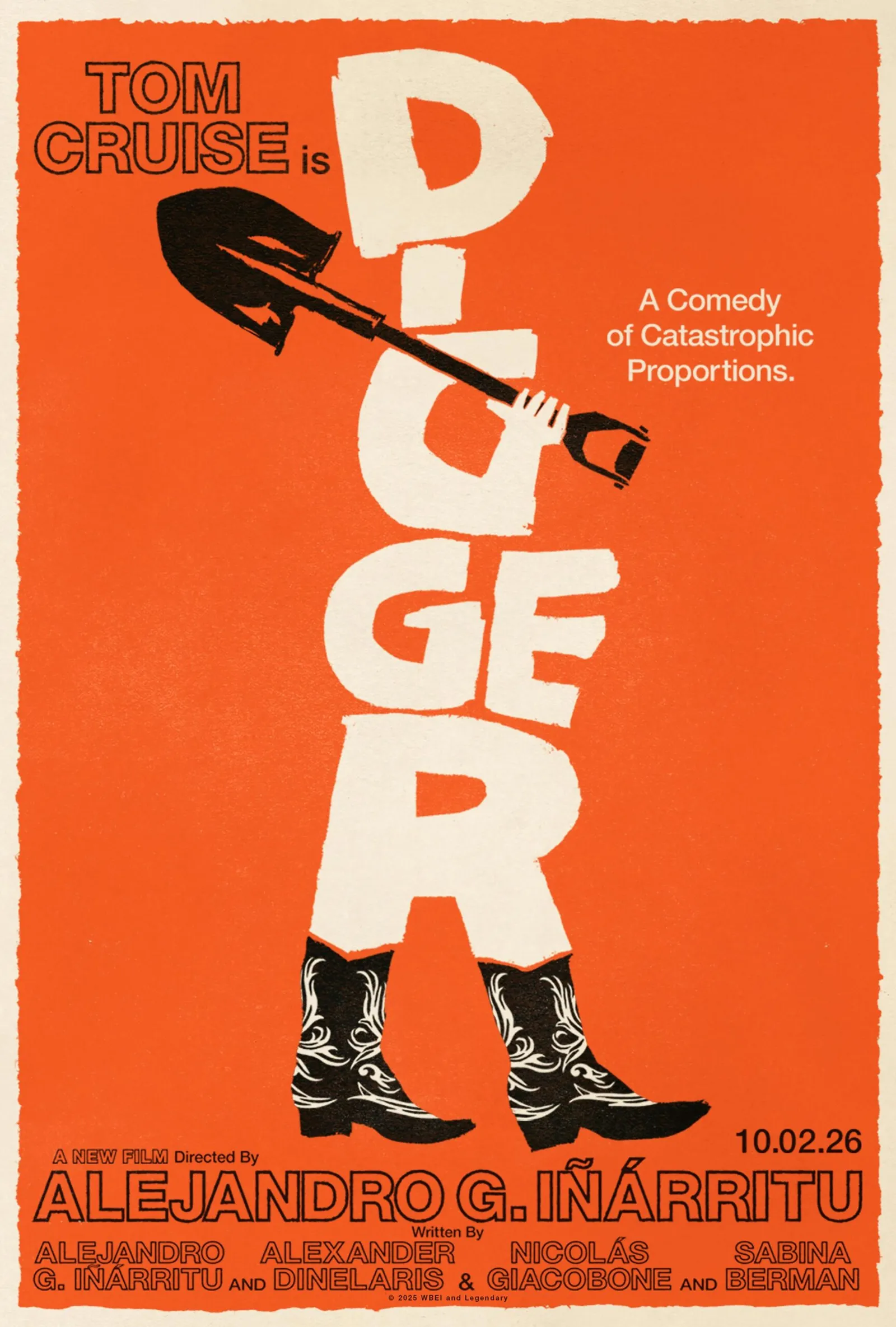
Digger (2026) is the sort of film that makes a familiar Hollywood question suddenly complicated: what happens when Tom Cruise plays a man who thinks he is saving the world, but may be the very reason it needs saving? Alejandro G. Iñárritu’s lavish dark comedy casts Cruise as Digger Rockwell, an extraordinarily influential oil tycoon racing to prevent a disaster that his own conduct has helped unleash. The role is the opposite of the calm competence audiences usually associate with the star.
This Digger (2026) review explores the film’s story without giving away its major structural surprises, the cast, the director’s wild visual style, the themes of power and environmental responsibility, and the unusually polarised critical reaction. Some reviewers consider the movie a rare example of ambitious mainstream satire; others see a tremendously expensive, exhausting lecture. The disagreement is almost as revealing as the plot.
Warner Bros. released Digger in US theaters on October 2, 2026, following international openings beginning September 30. The original screenplay brings Iñárritu together with Alexander Dinelaris, Nicolás Giacobone, Sabina Berman and Jez Butterworth’s story contribution. It was photographed entirely in VistaVision. These production and release details are confirmed by the official Warner Bros. movie website.
In this Digger review
Movie facts · Story · Tom Cruise · Themes · Direction and VistaVision · Cast · Reviews · Box office · Worth watching? · Where to watch · FAQ
Digger (2026) movie facts at a glance
| Title | Digger |
|---|---|
| US theatrical release | October 2, 2026 |
| International roll-out | Beginning September 30, 2026 |
| Director | Alejandro G. Iñárritu |
| Screenplay | Iñárritu, Alexander Dinelaris, Nicolás Giacobone and Sabina Berman; story credited to Berman, Iñárritu and Jez Butterworth |
| Starring | Tom Cruise, Riz Ahmed, John Goodman, Sandra Hüller, Michael Stuhlbarg, Jesse Plemons |
| Genre | Dark comedy, drama, satire |
| Runtime | 129 minutes (2 hours 9 minutes) |
| US rating | R for pervasive language |
| Cinematography | Emmanuel Lubezki; photographed in VistaVision |
| Production and distributor | Legendary Pictures / Warner Bros. Pictures |
These are useful expectations to establish before buying a ticket. Despite an impending disaster and a global-scale premise, the film is officially classified as comedy and drama rather than an action thriller. It features a major star and a spectacular production but is built around the idea of how people perform importance when reality demands accountability.
What is Digger (2026) about? The plot without spoilers
Digger Rockwell is a staggeringly wealthy oil executive who believes that power and money make him qualified to solve just about any problem. His influence reaches into rooms where decisions affecting millions are made, and his confidence barely wavers even when events begin to reveal the consequences of his actions. The world he inhabits is full of ritual, deference and people eager to remain close to power.
Then an environmental catastrophe threatens to become a crisis of almost unimaginable scale. Instead of withdrawing from public life or reckoning quietly with responsibility, Rockwell begins a frantic campaign to prove that he is humanity’s indispensable rescuer. There is one glaring contradiction in his heroic self-portrait: his own behavior was central to creating the threat.
The studio’s official synopsis places that contradiction front and center. It does not describe an innocent expert suddenly summoned to help the planet. It describes an extremely powerful man embarking on a mission to prove his value as the clock runs down. The difference matters because this is a story about the craving for recognition as much as about the urgency of stopping a crisis.
The supporting characters inhabit an environment where serious questions are constantly derailed by vanity, politics and public-image management. Rockwell wants the world to trust him, but the movie encourages us to ask whether someone who mistakes his position for wisdom can even recognise the limits of his understanding. That tension supplies the dark comedy.
The screenplay is known for changing its narrative perspective in ways that reviewers have debated extensively. Explaining how the more surprising elements work would undermine the experience for first-time viewers. For that reason, this overview deliberately stops with the premise and the character dynamics established in official publicity, rather than describing the later structural turns or final act.

Tom Cruise’s performance: the movie star as an unreliable savior
For much of his career, Cruise has made a particular kind of movie-hero competence look almost effortless. His characters run toward danger, master difficult skills and persuade us that individual commitment can overcome the impossible. His Rockwell in Digger flips those characteristics into an unsettling joke. Here is a man with all the confidence in the world and very little evidence that his judgment deserves it.
The costume, prosthetic makeup and expressive body language help separate the performance from Cruise’s established screen image. Rockwell looks and moves like someone who has become accustomed to being watched, photographed and deferred to. He is theatrical even when no audience is present, as though the story of his own magnificence must never pause.
That choice demands unusual generosity from a superstar: the character does not need to be likable. We can understand why people are drawn into his orbit without agreeing with a single word he says. His charisma becomes a tool with which power excuses itself, and the film asks us to notice when we respond to the performance rather than the person’s decisions.
Time Out’s review praised Cruise’s willingness to abandon his conventional leading-man instincts for a flamboyant, often abrasive comic role. Other writers took almost the opposite view, arguing that the film’s relentless emphasis on the character’s grotesqueness leaves little room for subtlety. Both positions make sense in light of Iñárritu’s strategy: Rockwell’s excess is not a flaw the movie is trying to disguise.
It is also a reminder that awards-worthy transformation and satisfying entertainment are not necessarily the same thing. Admirers may see Cruise doing something genuinely new and brave; detractors may find the heightened style too loud for a movie of this length. The performance is a major reason to be curious about Digger, but it is unlikely to win over every audience.

The movie’s real target: wealth, the environment and the need to be admired
The ecological disaster in Digger provides a compelling backdrop, but it is not the only subject. Iñárritu is interested in the uncomfortable distance between the consequences of power and the narratives the powerful construct about themselves. Rockwell has the resources to influence public policy and industrial decisions, yet he resists being defined by the damage his actions may have caused.
There is an especially sharp joke hidden in the film’s basic premise. To declare oneself a savior, one generally needs a crisis. Rockwell’s crisis is inextricable from his own decisions, and his rescue campaign therefore looks like a public-relations exercise staged on a planetary scale. The film repeatedly invites the viewer to ask whether doing good and being seen doing good have become indistinguishable to him.
A conventional disaster movie might focus on engineers racing to build a device, politicians debating evacuation, and families separated by unfolding chaos. Here the focus shifts to the people who occupy positions of influence and to their inability to behave normally under pressure. Their grand phrases and personal grievances are funny precisely because the stakes are so high.
The satire is not subtle, and it does not pretend otherwise. For some viewers, such directness will feel urgently relevant: they will recognise the language of elite exceptionalism, corporate marketing, manufactured heroism and the public appetite for a single charismatic answer to complex problems. For others, the same exaggeration will feel like a blunt instrument.
One of the movie’s most provocative questions is about spectatorship. Why are we so receptive to a story in which a powerful figure becomes the one person capable of solving a crisis? Is it a comforting dramatic formula, a way to avoid thinking about collective responsibility, or simply a story that makes for entertaining cinema? Digger repeatedly disturbs the usual boundaries between those explanations.
Alejandro G. Iñárritu, VistaVision and the pleasure of excess
Iñárritu has long been fascinated by performance, ego and the visual staging of human conflict. Birdman used ambitious choreography and dark humor to investigate the need for recognition, while The Revenant pushed natural environments and physical endurance into the center of the viewer’s experience. Digger is not a remake of either approach, but the ambition to make the form inseparable from the subject is recognizable.
The film was photographed in VistaVision, a high-resolution 35mm film system that runs film horizontally rather than vertically through the camera. The studio highlighted that technical choice in its official release material. The detail matters here because large images and carefully staged spaces allow the film to make wealth and influence seem both magnificent and absurd.
Cinematographer Emmanuel Lubezki, who has worked extensively with Iñárritu, brings an unusually textured visual sensibility. Vast interiors, formal compositions, elaborate practical details and expressive lighting reinforce Rockwell’s hunger for grandeur. The camera is not merely recording the action; it is also examining the world the character has built around himself.
The cast and crew include production designers Dennis Gassner and Richard Johnson, makeup and prosthetics specialists Alessandro Bertolazzi and Kazu Hiro, and composer Cosmo Sheldrake. Their combined work supports a film that seems eager to overfill the frame and the soundtrack, as though the entire world were competing to be heard.
Yet formal bravado carries a risk. Images may become more memorable than ideas, and elaborate comic scenes can slow an already complicated narrative. This is the source of much of the divided critical response: the movie’s extravagance is its distinctive identity, and also the quality most likely to alienate someone looking for clarity and restraint.

Digger (2026) cast and crew
One of the strongest selling points is the ensemble surrounding Cruise. Warner Bros. confirms the principal performers and production credits; detailed character descriptions have not been consistently published for everyone, so we will not manufacture them.
| Actor | Role or involvement |
|---|---|
| Tom Cruise | Digger Rockwell, the exceptionally powerful oil magnate |
| Riz Ahmed | Principal supporting performer |
| John Goodman | Part of the ensemble around Rockwell |
| Sandra Hüller | Principal supporting performer |
| Michael Stuhlbarg | Supporting cast |
| Jesse Plemons | Supporting cast |
With actors capable of both comedy and dramatic precision, Iñárritu has the tools to create conflicting registers of seriousness and absurdity. Rockwell’s speeches are often only half the point: the responses of other characters show how influence alters everyone’s behavior. At times an awkward pause or an incredulous look exposes more than a long declaration about responsibility.

Digger reviews: why critics and audiences disagree
As of October 20, 2026, Rotten Tomatoes listed approximately 53% positive reviews among critics from 333 published reviews, while 76% of verified audience ratings were positive across more than a thousand responses. These are positivity rates rather than star ratings, and they can change as new responses arrive.
Those percentages tell a useful story: the movie has clearly found admirers, even if it has also frustrated a significant share of reviewers. The disagreement concerns more than whether a joke lands. It concerns what sort of film Iñárritu intended to make and whether a Hollywood satire can justify being deliberately exhausting.
Time Out awarded the film four out of five stars, embracing its unpredictability and savage sense of humor. By contrast, Screen Daily described it as an ambitious misfire, pointing to the unsubtle approach and an uneasy combination of ideas. The Guardian was more dismissive, criticizing what it saw as an exasperatingly self-satisfied satire.
Rotten Tomatoes’ first-review roundup makes clear that some of the same formal choices inspire opposite reactions. An elaborate structure may feel daring or distracting; a performance may seem fearless or overplayed; the movie’s desire to make a grand statement may seem necessary or irritating. It is a genuinely divided reception rather than a simple tale of critics misunderstanding an obviously beloved picture.
A review aggregator cannot answer the question of whether you personally will enjoy it. But it helps clarify the viewing proposition. This is a risky mainstream film whose ambitions are large and whose restraint is intentionally limited. Readers may find the debate around it almost as interesting as the finished work.
Digger at the box office: a costly risk
The theatrical opening did not match the sort of box-office expectations traditionally associated with a major Tom Cruise release. The Los Angeles Times reported roughly $8 million in domestic opening-weekend receipts, a disappointing start for a major studio picture with this degree of star power and production expense.
Poor early receipts should not be confused with proof that a film has no artistic value. Nor does a fascinating production justify every narrative decision. The interesting question is whether studios can continue financing lavish author-driven experiments that do not fit easily into established marketing categories.
Cruise’s previous commercial successes are built on a different promise: high-concept action, a recognisable hero, and immediate payoff. Digger asks viewers to commit to satire, discomfort and a protagonist whose ethical shortcomings are the point. The gap between those promises helps explain why the movie has become a conversation about cinema’s appetite for expensive creative risk.

Is Digger (2026) worth watching?
Digger is worth considering if you’re interested in morally messy protagonists, dark comedy, political and environmental satire, or the sight of Tom Cruise deliberately subverting his familiar screen image. It has the resources of a major studio film and the temperament of a director more interested in making an argument than delivering a comfortable night out.
At its most intriguing, the premise opens questions about who gets to call themselves a hero and whether immense influence actually equips someone to solve the damage they caused. Cruise’s unconventional performance is the natural focal point, but the impressive supporting cast and VistaVision cinematography are important attractions too.
The warning is equally clear. Anyone hoping for a straightforward disaster thriller or another gravity-defying Cruise action adventure may find the experience confusing and irritating. The comedy is aggressive, the pace is not designed for universal pleasure, and critics disagree sharply about whether the film’s complexity is earned.
It may ultimately be more rewarding to approach this as a deliberately divisive artistic experiment than as an event movie required to satisfy everyone. Viewers open to that bargain may discover something genuinely unusual; others may come away convinced that the director mistook grandiosity for insight. Both reactions are reasonable outcomes of such an uncompromising project.
Where to watch Digger (2026) legally
As of October 20, 2026, Warner Bros. continues to present Digger as a theatrical release. Its official website, Digger Movie, offers a cinema ticket and showtime finder. The US opening date is October 2, with international openings beginning September 30; screenings depend on the country and local distribution.
No official date for digital rental, purchase, or streaming subscriptions has been confirmed in the distributor material reviewed for this article. Some websites have estimated when the film might arrive on home platforms, but those predictions are not announcements. We will not claim that a full free version is officially available simply because the movie has a promotional video online.
For more releases from the same period, our October horror and thriller guide covers different genres, while the October 16–18 weekend watchlist offers several viewing alternatives. Both are editorial recommendations rather than substitute streaming sources.
Digger (2026): frequently asked questions
When was Digger (2026) released?
Warner Bros. released Digger in US theaters on October 2, 2026, with international theatrical releases starting September 30.
What is the movie Digger about?
Oil tycoon Digger Rockwell tries to convince humanity he can avert a massive disaster, despite the fact that his actions helped create the danger.
Who plays Digger Rockwell?
Tom Cruise stars as Digger Rockwell, the influential business magnate at the center of the satire.
Who directed Digger?
Alejandro G. Iñárritu, the filmmaker behind Birdman and The Revenant.
Is Digger an action movie?
No. Although the premise includes an enormous threat, its principal genres are comedy and drama, with a distinctly dark satirical tone.
How long is Digger (2026)?
The film runs for 129 minutes, or two hours and nine minutes.
Why are Digger reviews so divided?
Critics disagree about the exaggerated acting, elaborate filmmaking and intentionally abrasive satire. Some praise its ambition; others find the approach overly heavy-handed.
Is Digger available to stream?
As of October 20, 2026, the confirmed release is theatrical. Warner Bros. has not announced an official date for subscription streaming in the sources reviewed.
Does Digger contain major twists?
Yes. The film experiments with narrative form and perspective, and this review avoids explaining those surprises or the ending.
Sources and editorial method
Release dates, casting, VistaVision and production credits were checked against the official Warner Bros. movie site. Rating, runtime and critical versus verified-audience positivity figures: Rotten Tomatoes. Attributed critical reactions: Time Out, The Guardian and Screen Daily. Opening-weekend figures: Los Angeles Times. The interpretation presented here does not claim an unverified first-person screening, and the story discussion omits structural spoilers.
Editorial update: October 20, 2026. Film stills and promotional photographs include individual source credits. All imagery © Warner Bros. Pictures / Legendary Pictures and its respective owners.